TradeJournal
Enter your access PIN to continue
·
Setup / API Key
Tradier API Setup
One-time setup. Free. No credit card. Powers live options chains, the Income Scanner, CSP Finder, and all Tradier fill buttons.

The 5-Step Process Disciplined Execution

1
Scan 33 scanners surface options flow, momentum, income, and volatility candidates.
2
Chain Live Tradier chain fill. Contract card + greeks. ATM auto-select. Strategy-aligned calls/puts.
3
Calculate 50-Enhancement risk framework, full P&L math, breakeven, cushion, credit %, sizing.
4
AI Review Orbit Light Cascade (4-role, 12 GB+) for speed · Heavy Cascade (6-role, 40 GB+) for institutional depth · or Gemini 2.5 cloud. Rules fixed, AI explains.
5
Execute Paper trade in Tradier sandbox. One-click Discord alert. Full journal entry logged.

Platform Capabilities

33+ Scanners 15+ Option Strategies Orbit AI Cascade Light · Heavy · Adaptive 3-Platform Installer Paper Trading · Tradier Gemini 2.5 · Local Ollama Discord Alerts 35+ WeeklyPay ETFs

Mission Goal

Scale from $500 to $10,000 through disciplined 24-trade sequences. This OS provides the institutional-grade research and AI-coaching required to survive the learning curve.
Sandbox Token — Free
Powers paper trading. Free at developer.tradier.com — no broker account, no credit card. Delayed 15 min. All virtual orders route here.
Production Token — Live Data
Powers live chain pulls, movers, Income Scanner, CSP Finder. Requires a Tradier brokerage account. Real-time quotes.
Tradier Tokens
Sandbox Token · Paper Trading
Saved in your browser only. ⚠ Safari Private Mode: use a regular tab.
Production Token · Live Data Pulls
Used for live chain pulls and scanners. Never touches paper orders.
Robinhood MCP
Local OAuth Bridge · 127.0.0.1:8791
Preferred: run the local Robinhood bridge started by Install-TradeOps-Autostart.command. The token box is legacy fallback only; do not paste masked saved-token previews.
AI Picker API
Connect Strategy Calc to your picker endpoint. The journal sends the editable calculator snapshot plus your PCS picker rules to your bot or relay, then saves returned picks in the AI Pick Inbox.
Request Schema
trading-journal.ai-picker.request.v1
POST JSON with Authorization: Bearer <picker-api-key>.
Primary Strategy
Put Credit Spread
Built for weekly income review on $1,100–$2,000 accounts.
Hard Filters
21 DTE · 0.20–0.30 Δ · $0.30+
No earnings inside 21 days. Cushion 5%+. Credit ≥20% of width.
Recommended local mode: Light Cascade. Run the relay with AI_PROVIDER=light-cascade, then use the quick setup buttons below. MariaDB is auto-started by the relay script when installed — ticker library + AI memory build automatically on every chain fetch. Nemotron stays archived for cloud/GPU hardware.
Saved in this browser only. Use the local Ollama relay for cheap tiers, or point this at a cloud relay. Put AI provider keys and Discord bot tokens on the relay, then give the journal only the picker URL and picker key.
MariaDB starts automatically — the relay script brings it up if it's installed. Not installed yet? Run bash prototypes/install-mac.sh --with-memory (Mac) or sudo bash prototypes/install.sh --with-memory (Linux) once to set it up.

Mac quick start: click Open Terminal to download install-tradeops-relay.command → double-click it in Finder. Installs Homebrew + Node + Ollama + all AI models + relay as a login service (~25 GB, 20-60 min). Already installed? It just restarts and shows your key.
Windows: click Open Terminal to download install-tradeops-relay.ps1 → right-click → Run with PowerShell. Installs Node.js + Ollama + AI models + relay as a Task Scheduler service (~25 GB, 20-60 min). Already installed? It just restarts and shows your key.
Linux: click Open Terminal to download start-tradeops-relay.shchmod +x and run it.
Relay Benchmark
Runs a standard SPY prompt through all configured models and measures latency, tokens/sec, and reports VRAM requirements. Use this to gauge GPU/hardware needs.
Discord PCS Alerts
Paste an Incoming Webhook URL for the Discord channel that should receive PCS alerts. The Income Scanner posts qualifying Put Credit Spread candidates when they score 6/8 or higher.
Saved in this browser only. Keep webhook URLs private because they can post messages into their Discord channel.
AI Provider — Trade Advisor
Select your AI provider for stock analysis, news research, and options guidance. All three support up-to-date market commentary. Keys are stored only in this browser.
⚡ Relay Environment Sync
Push all saved API keys from this browser directly into your local relay's .env file with one click. The relay restarts automatically — no terminal needed.
ORATS — Real Greeks for Paper Trading
ORATS supplies real-time delta, gamma, theta, and IV to the paper trading chain picker — filling in the Greeks that Tradier sandbox doesn't return. Your key is stored only in this browser.
AlphaVantage — News Sentiment
Powers the News Sentiment badges on lead cards and the market indices bar. Free tier: 25 requests/day. Get a key at alphavantage.co.
IBKR Client Portal
A local Java gateway at port 5001 serves both live market data and the DUQ503990 paper account. Start it once per session, authenticate via browser, then the relay keepalives it every 55s automatically.
Gateway · localhost:5001 (DUQ503990)
Open Login ↗
What This Unlocks
⚡ Income Scanner — scans SPY, QQQ, IWM and your watchlist for put credit income, long calls, and bull call spreads with auto-scoring
📊 Strategy Calc — pull any options chain live, click a row to auto-fill the P&L calculator
🔍 CSP Finder — enter any ticker, auto-finds the best 0.25 delta put at 30-45 DTE
📈 Spread Builder — pull both legs of any spread from the live chain instantly
💰 Position Sizing — pull the live ask price for any specific contract to size your trade
Product Routes / Current Build
TradeOps Research Desk
A local-first options workflow: scan candidates, verify chains, calculate risk, ask AI to explain locked facts, paper test, then journal the outcome. Educational research only, not financial advice or order-entry instruction.
Current Product Loop
1
ScanScanner Library, Cross-Confirm, Income Scanner, SMC Bias, Leveraged ETF tools, Market Intelligence, Watchlists, and Arcade parsers surface candidates.
2
Verify DataTradier sandbox, Tradier production via relay, ORATS Greeks, chart data, FRED macro context, and IBKR quote fallback confirm the setup.
3
CalculateStrategy Calc and tradeops-algorithm.js lock PCS/CSP gates, DTE, delta, liquidity, IV, cushion, spread quality, and account sizing.
4
AI ReviewBrowser keys or relay routes explain locked facts through local Ollama, Gemini, xAI/Grok, OpenAI-compatible, light cascade, and vision/chart reads.
5
Paper, Alert, Store, ReviewTradier paper flow, optional IBKR Client Portal context, Discord alerts, AI Pick Inbox, Trade Log, Weekly Review, MariaDB memory, and warehouse writes close the loop.
Live Deployment
Cloudflare Pages: trading-journal-options.pages.dev
Main app: trading-journal-v5.2.html#product
Lead gate: Cloudflare Worker tradeops-verify + Gumroad license keys
Static lead data: pipelines/outputs/trade_leads.json
Project Truth
The core journal is static HTML/CSS/JS. Relay, broker access, ORATS, Discord, MariaDB memory, warehouse storage, and paid lead verification are optional product layers.
Product Routes
Route A
Local AI Desktop
Run the static app plus localhost relay. Use Ollama, Gemini/xAI/OpenAI-compatible fallbacks, Tradier context, optional MariaDB memory, and mostly private workflow context.
Route B
Managed Relay
Same HTML app, but Picker API points to a hosted relay for AI review, market-data proxying, chart reads, watchlists, lead refresh, and subscription tiers.
Route C
Delayed Leads
Pipeline-generated trade_leads.json feeds delayed-leads.html. Free view can show a limited queue; Gumroad + Worker KV unlocks the fuller delayed research board.
Route D
Bring Your Own Data
Use MariaDB/MySQL or SQL Server schemas for bars, features, and compact AI context. Keep raw history in the database, not browser prompts.
Route E
Broker-Connected Research
Tradier paper/live data, ORATS Greeks, IBKR Client Portal status, portfolio context, quote fallback, what-if/order routes, and account-aware AI review.
Relay Contract
Local URL: http://127.0.0.1:8787
Auth: Authorization: Bearer PICKER_API_KEY
Picker URL: http://127.0.0.1:8787/api/picks
AI endpoints: /api/picks, /api/chain-scan, /api/ticker-read, /api/web-read, /api/chart-read, /api/algo-review
Research endpoints: /api/news, /api/intelligence-scan, /api/catalyst-scan, /api/strategy-fit, /api/confluence
Data endpoints: /api/market, /api/chart-data, /api/fed-data, /api/warehouse/*, /api/rag-corpus, /api/forex/rates
HTML rule: use pickerSiblingUrl('/api/...'), pickerGetKey(), and AbortSignal.timeout(...).
AI Routing
Providers: local Ollama, light-cascade, Gemini, split/hybrid, OpenAI-compatible, xAI/Grok.
Local defaults: llama3.1, 0xroyce/plutus, qwen2-math, wizard-math, reader-lm, qwen3-vl.
Gemini defaults: gemini-3.5-flash, gemini-3.1-pro-preview, gemini-2.5-flash vision.
Rule: deterministic scanner, strategy, liquidity, and sizing checks stay in code before AI writes the explanation.
Storage Layers
Browser localStorage keeps journal state. MariaDB memory keeps recent scans. Warehouse schemas keep long-term OHLCV and feature history.
memory_event recent_bar lead_snapshot daily_price
Broker / Data Boundaries
Tradier sandbox: delayed data and paper workflows.
Tradier production: live quote/chain proxy through relay.
IBKR gateway: account context and Client Portal order routes; credentials stay in the gateway browser flow.
ORATS: real option Greeks for paper chain views.
Paid Lead Flow
Worker: tradeops-verify
KV binding: LICENSES
Product: TradeOps Real-Time Leads, permalink leads, founding rate $29/mo.
Access: /verify?token=<license> unlocks paid lead data.
Compliance Language
TradeOps provides educational research tools and delayed research leads. It does not provide financial advice, investment recommendations, or order-entry instructions. Verify all data, pricing, liquidity, earnings, risk, and suitability before trading.
Overview / Dashboard
Mission Control
Your $500 → $10,000 challenge objective. Track every trade, monitor progress, and stick to the 24-trade sequence.
Progress to Goal
0%
$0$2,500$5,000$7,500$10,000
Challenge Sequence
Recent Activity
Research / Market Intelligence
Market Pulse
Live market movers, economic calendar, and your weekly research queue.

Market Movers Active & Trending

Weekly Watchlist Research Queue

Economic Calendar Macro Catalysts

Overview / 24-Trade Map
The Sequence
Four phases. Six trades each. Scale capital as conviction grows.
Phase 1 — Learning (1-6)
Max $150/trade · Debit spreads only · Document every decision · Process over P&L
Phase 2 — Building (7-12)
Max $250/trade · Must hit 2+ scanners · Full 3-step checklist · Score 4+
Phase 3 — Scaling (13-18)
Max $400/trade · Highest conviction · Chain anomaly required · Score 8+
Phase 4 — Target (19-24)
Max $600/trade · Full system · All 6 chain items · Fund score 5+
Scanners / Library
Scanner Library
All 33 scanners with exact parameters. Fidelity first, Cboe and SMB/LiveVol flow next, then People scanners.
SMB Options Scanner Playbook
Core execution rule: No scanner is an automatic trade. Confirm chart structure, VWAP, SMI/MACD, option-chain liquidity, bid/ask spread, and a clear trigger level before execution.
Stack workflow: Run MB Dark-Pool Proxy, then MB Call Flow Anomaly, MB Put Flow Anomaly, and MB IV Explosion / Event Radar. Compare overlaps before taking any setup seriously.
Confirmation: Price above VWAP plus call-heavy flow leans bullish. Price below VWAP plus put-heavy flow leans bearish. Heavy calls and puts together is a volatility watch, not a direction by itself.
Chain review: Confirm volume, open interest, delta, spread, expiration, and whether IV expansion makes long premium risky.
Small-Account BaselineMinMax
Last$3$50
Volume1,000,000
Average Volume300,000
Percent Average Volume125
Option Volume500
Average Option Volume200
Fidelity Stock Screener10 Scanners
Cboe LiveVol Options9 Scanners
SMB / LiveVol Playbook10 Scanners
People Scanners4 NEW
Penny & Small-Cap3 NEW
Live Quote Check — Tradier
Scanner Library Chart — TradingView
Search tickers above, then chart the best names here.
Run a quote search, click Chart on a result, or enter a ticker manually.
Daily Workflow
9:00am Pre-Market
Pre-Earnings Beat Hunter · Earnings Whisper · Cboe Position Increase
9:30-10:30am Open
Morning Momentum · Institutional Flow · Small Account Scanner · All 4 Cboe activity scans
10:30am-2pm Mid
Retail Sentiment · Dark Pool · Bullish/Bearish Delta · IV30 vs HV30 · Sector Rotation
4:15pm After Close
Pre-Earnings Beat Hunter tomorrow · Downtrend Put Finder · Earnings Whisper next 7 days
Daily Workflow — What Each Window Actually Means
9:00 AM Pre-Market: Build the watchlist only. Do not force orders. Look for earnings names, overnight OI builds, major news, premarket volume. Goal: know which tickers deserve chain review at open.
9:30-10:30 AM Open: Confirm moves with real volume. Check Morning Momentum, Institutional Flow, Small Account Options Flow, and Cboe activity. Avoid buying the first candle. Let spreads settle.
10:30 AM-2:00 PM Midday: Confirmation time. Is retail sentiment supporting or warning? Dark pool confirms direction? IV30 vs HV30 — is premium elevated? Is the stock holding levels or fading?
4:15 PM After Close: Review, do not chase. Run next-day earnings scans, Downtrend Put Finder, Earnings Whisper checks. Log what worked and failed so the next morning is not emotional.
Scanners / Cross-Confirm
Cross Confirm
Check which of your 33 scanners flagged this ticker. Need 2+ to proceed.
0
/ 33 scanners
Skip
Check which scanners found your ticker today
Research / 3-Step Process
Research Protocol
Every trade must pass all 3 steps. No exceptions. No shortcuts.
1
Scanner Confirmation
Must appear on 2+ of 33 scanners. Use Cross-Confirm page to score quickly.
2
Options Chain Analysis
Find the edge. Identify the anomaly. Check all Greeks. Reject instantly if it matches a bad example below.
IV / Theta / Gamma Guide
IVBest: IV30 above HV30 but not absurd. For long calls/puts avoid paying max ask when IV is already over 100% unless catalyst is confirmed. Watch for IV crush after earnings.
ΘTheta: Prefer theta burn under 5% of premium per day for small account singles. Under 7 DTE treat it as a lotto — cut fast if price stalls.
ΓGamma: High gamma is good only when the stock is moving now. If gamma is high but volume fades the contract can collapse fast. Best for breakouts near the strike.
PASSPreferred long-premium combo: Delta 0.25-0.60, theta burn manageable, non-zero bid, OI 500+, volume 100+, spread under 10% of mid, IV supported by real catalyst, total risk fits buying power.
Bad Examples — Auto-Reject Training
REJECT Zero-bid OTM lotto
$0.00 bid / $0.05 ask, volume 0, 300%+ IV, far OTM. Looks cheap but there may be no exit.
Fix: Only consider if bid is non-zero, OI 200+, spread is tight enough to sell later.
REJECT Wide-spread trap
Bid $1.80 / ask $6.30 with volume 0. The midpoint is fake — you get robbed on entry and exit.
Fix: Reject if spread is greater than 20-30% of mid unless you are placing a lowball limit.
REJECT Oversized position
5 contracts costing $278 when buying power is $114. That is not a trade — that is account damage.
Fix: 1 contract first. Max risk stays inside phase cap and below available buying power.
REJECT Chasing a 40% rip
Stock already up 35-40%, trying a low limit. The move already happened. You are the exit liquidity.
Fix: Wait for pullback or skip. Never chase a stock near the 40% danger rule.
CAUTION 3-DTE gamma scalp
$0.10-$0.15 call, gamma ~0.91, theta -0.028/day. Can explode but stalls kill it fast.
Fix: Same-day scalp only. Enter near bid/mid, take profit quickly, cut if underlying stops moving.
GOOD Clean small-account candidate
Price $3-$15, OI 200+, non-zero bid, spread under 20% of mid, delta 0.20-0.50, theta survivable, clear catalyst.
Action: This is the setup that moves to the trade ticket after scanner + chain + catalyst confirmation.
3
Fundamental Validation
Real catalyst, real business, real reason. Score 4+ required to trade.
0
/ 12 checks
Incomplete
Complete chain and fundamental checks
Research / Rotation Plan
Sector Rotation
Your complete sector rotation playbook. Track every sector in real time, score rotation signals, log trades, and follow the MA exit system. Industry tide beats individual stock every time.
Live Sector Performance
Requires Tradier token — press Refresh to load live sector data.

Sector Overview Market Context

ETF Heatmap Global Capital Flow

Live Sector Scorecard Weekly Rankings

Rate each sector weekly. Green = rotate in. Red = rotate out. Amber = monitor. Click any row to update your score.

Sector ETF 50d MA 150d MA 3M Perf Volume Signal Your Score Action
Tradier can fill the MA, 3M performance, and volume cells. All fields remain manually editable.

Sector Multi-Chart Technical Analysis

XLK — Technology
Click a sector button above to load the chart.

Entry Signal Checklist Score Before Trading

Run this protocol every Sunday or before entering a new sector position. Need 6+ to trade. Need 9+ to size up.

0
/ 10 signals
Skip
Complete the checklist above

Rotation Protocol Step 1: Read the Scoreboard

Rank all 11 sectors by 3-month and 6-month performance. Look for rising price plus rising volume — not opinions.

BUYSector in top 3. ETF above 50-day MA. MA sloping up. Institutional volume above average.
WATCHSector moving from bottom half into top half. MA flattening/turning up. Early signal.
AVOIDSector in bottom 3. ETF below both MAs. 150-day MA sloping down. Money already left.
EXITSector drops below rank 5. Volume dries up. Price below 50-day MA for 2 consecutive days.

Rotation Protocol Step 2: Buy the Basket

Once the winning sector is identified, use a sector ETF before individual stocks. Reduces single-company risk.

ETFSectorIV RankPCS Viable?Best For
SPYS&P 50012-20%✓ Tier 1Weekly Income
QQQNasdaq 10015-25%✓ Tier 1Bull Call Spreads
IWMRussell 200018-30%✓ Tier 1Small Cap Rotation
SMHSemis / AI25-40%✓ Tier 2Breakout Spreads
XLFFinancials15-22%✓ Tier 2Rate Stability Plays
XLEEnergy20-35%✓ Tier 2Commodity Trends
Rule: Always confirm the ETF first. If SMH is flat, your NVDA chip rotation thesis is wrong.
Strategy: Use PCS on Tier 1 (SPY/QQQ). Use Call Spreads on Tier 2 (SMH/XLF).

Rotation Protocol Step 3: MA Exit System

The 150-day moving average is your hard exit guardrail. No narrative overrides it.

BUYPrice > 50d MA + Slope Up. Institutional accumulation confirms.
WARNPrice < 50d MA. Review thesis. Tighten stops. No adding.
SELLPrice < 150d MA + Slope Down. Hard exit. Distribution complete.
HOLDPrice > Both MAs + Slope Up. Trend is healthy. Monitor.
Hard Stop: Price closing below the 150-day MA is an absolute liquidation signal.
Re-entry: Must reclaim and hold 50-day MA for 3+ sessions.

Case Studies Signal Analysis

AAPL — Textbook Buy
50-day MA slope turned up before breakout.
Volume expanded on breakout day.
Sector (XLK) confirmed rotation.
GLD — Heartbeat Pattern
Broke above 50-day MA with major volume.
Quiet accumulation followed by explosion.
Exit respected on first MA breakdown.
NKE — 150-Day Breakdown
Decisive break below 150-day MA.
Slope turned down — hard exit.
Brand quality did not override selling.

Weekly Review Sunday Protocol

Personal Command Sheet Strategic Focus

$0
max risk
Rotation Ready
Research / Street Setups
Street Setups
Chart patterns to combine with scanners, chain liquidity, and Greeks. Setup filters — not automatic buys.

Live Setup Router Trend Analysis

Chart — TradingView auto-loads on search

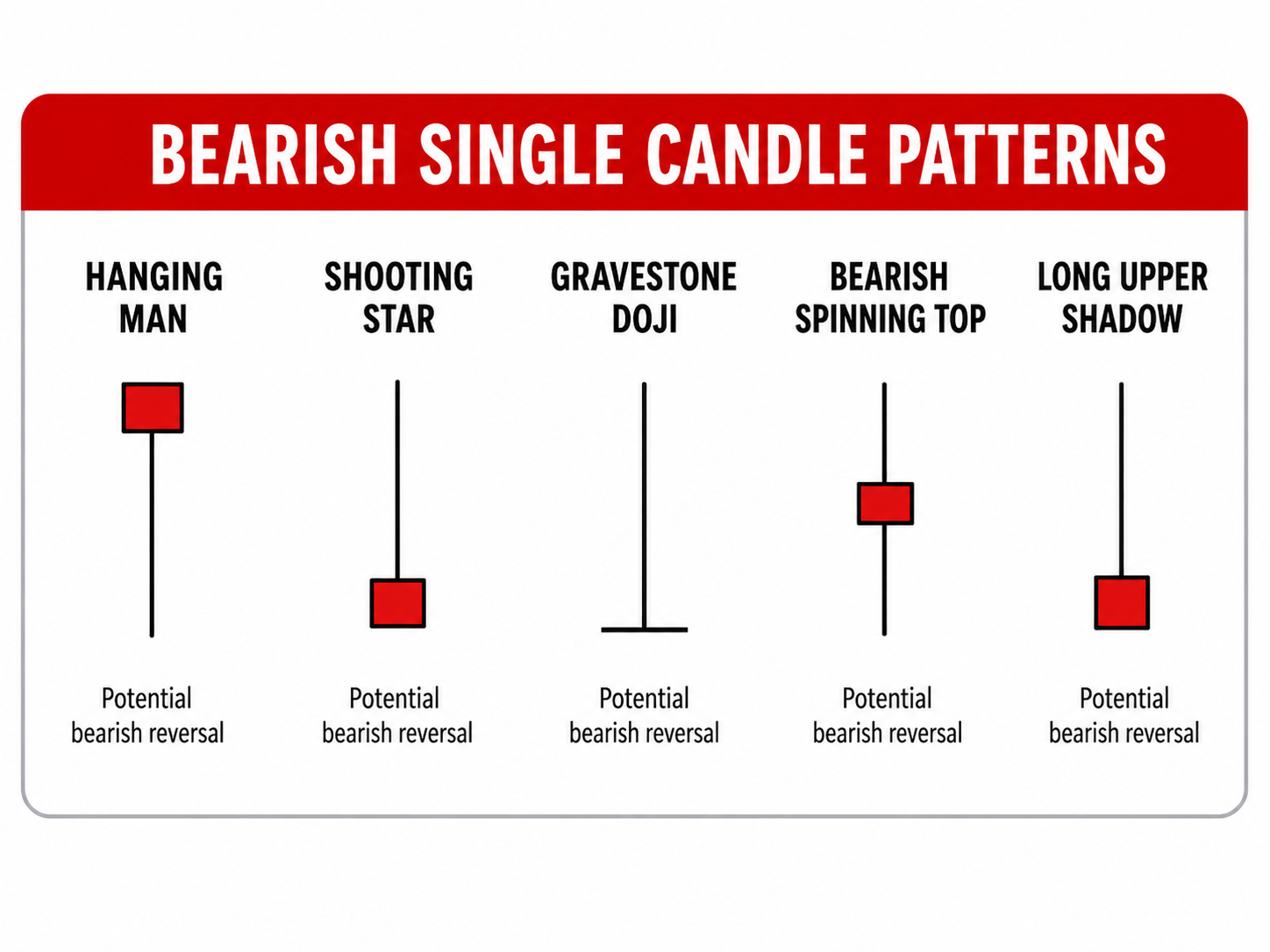
Candlestick Pattern Sheet Visual Reference

Patterns are confirmation evidence — not automatic orders. Use with trend + level + volume + chain.
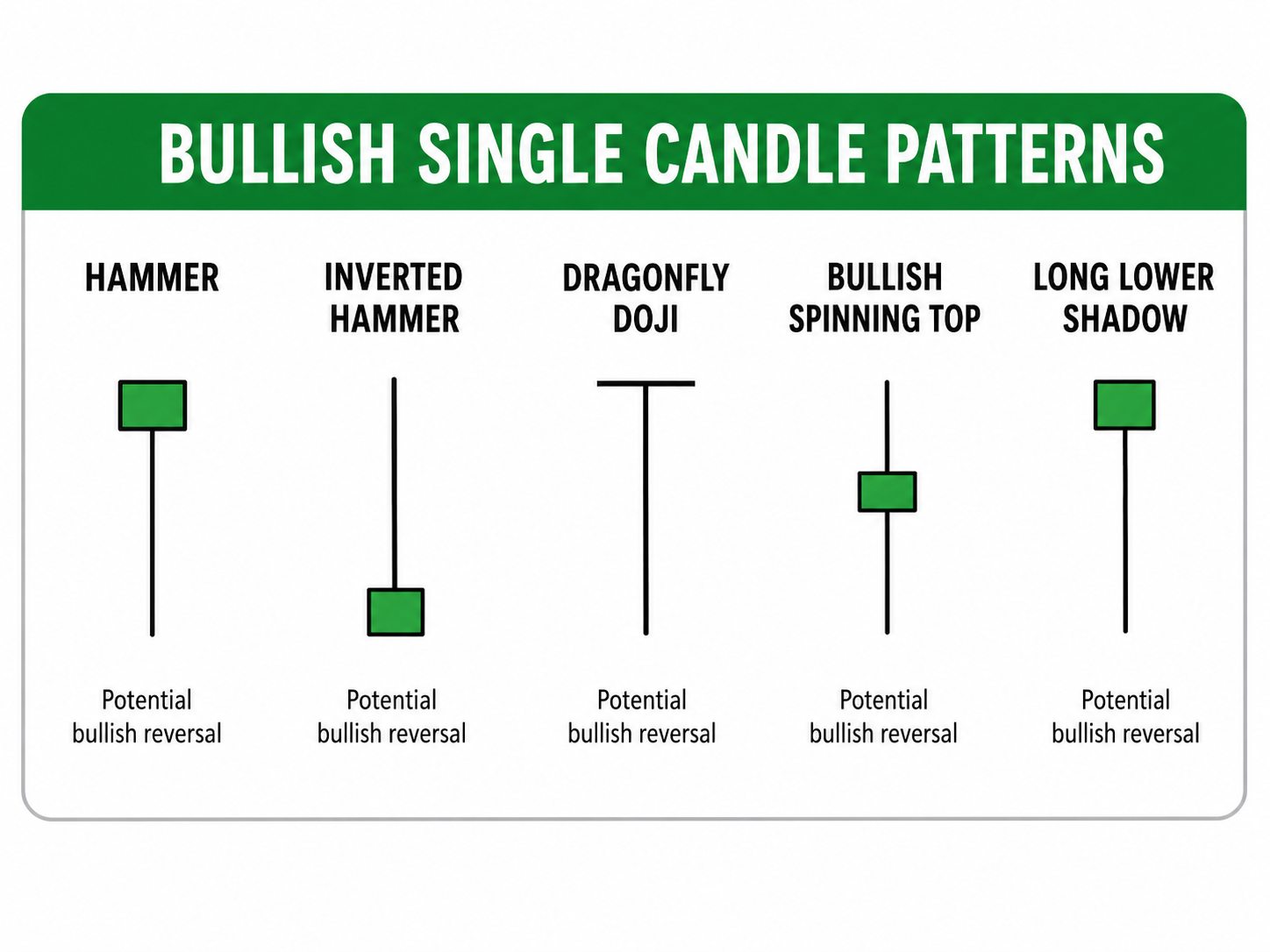
Pattern Sheet
Institutional pattern recognition rules.
Bullish
Bullish Reversal — best at clear support levels.
Bearish
Bearish Reversal — best at resistance peaks.
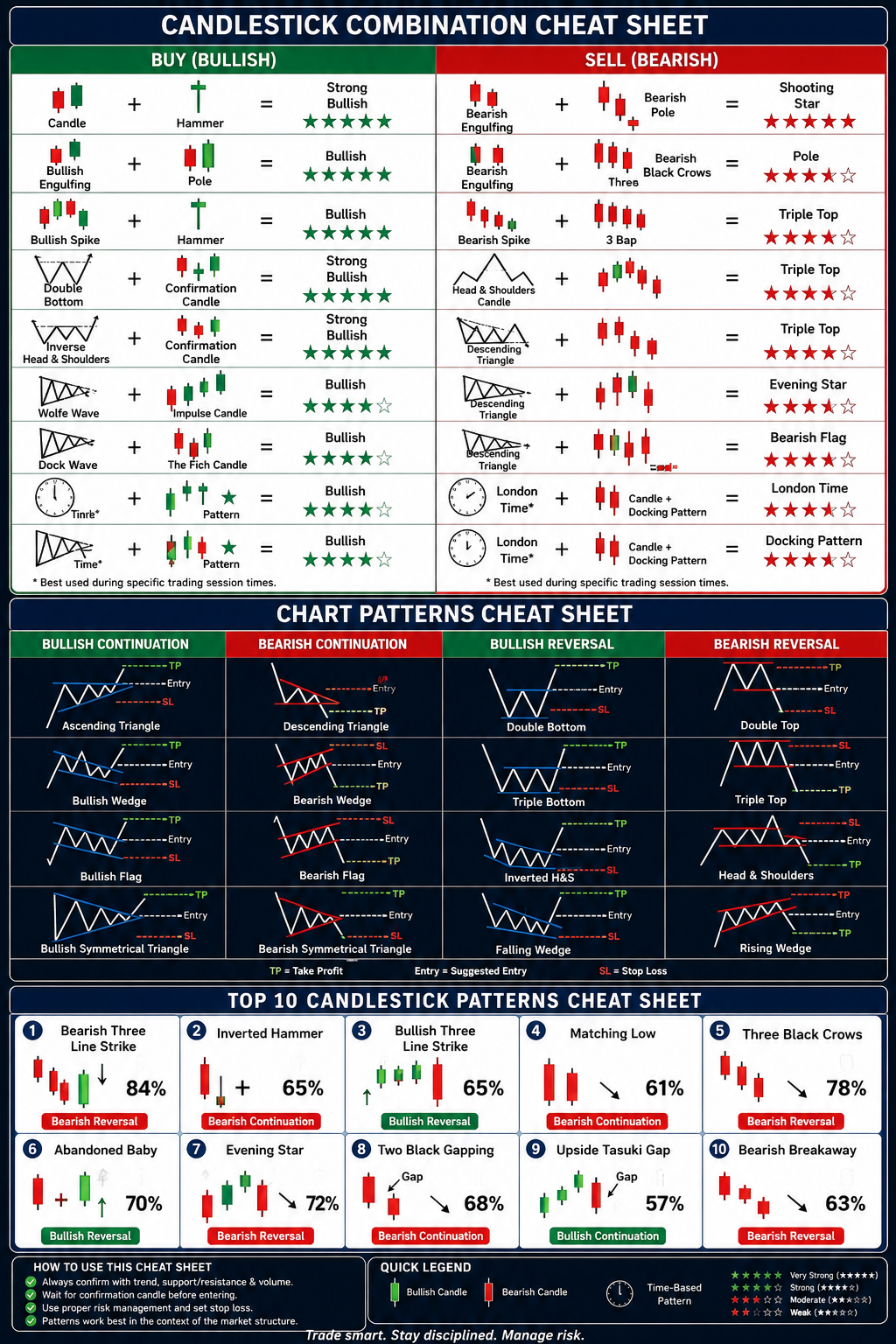
Candlestick Combination Cheat Sheet

Bullish/bearish candle combos · chart pattern types (continuation + reversal) · top 10 high-probability setups. Reference panel — pair every pattern with scanner confirmation, level, and chain check.

Candlestick combination and chart pattern cheat sheet
Patterns work best in the context of the market structure — trend, key level, and volume. A pattern alone is never a signal.
Price Action Cheat Sheet

Master reference — candlestick patterns + chart patterns + entry rules. Use patterns with trend, location, and confirmation — not in isolation.
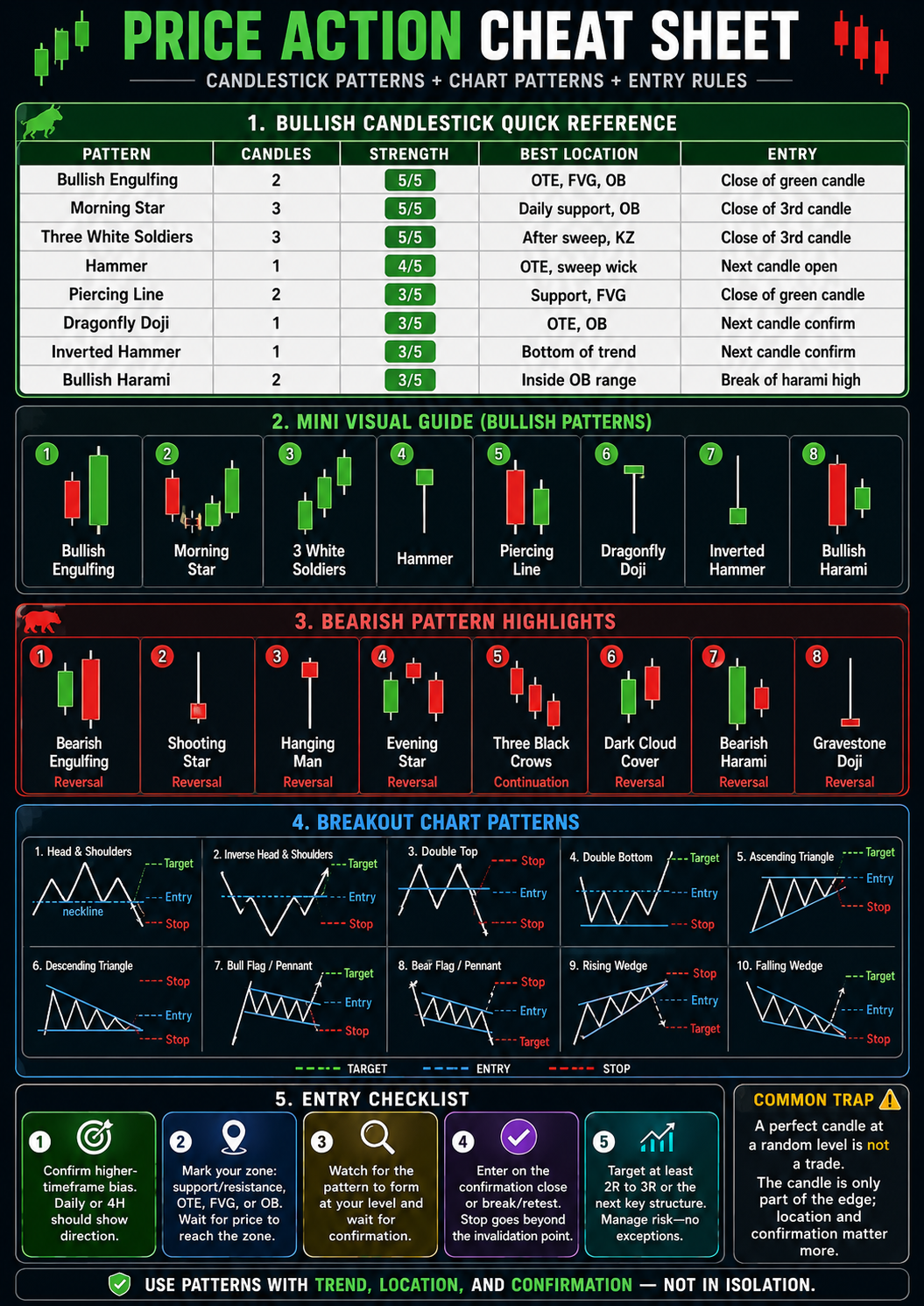
Price action cheat sheet — candlestick patterns, breakout patterns, entry checklist
① Bullish Quick Reference
5/5 Engulfing: OTE, FVG, OB → close of green candle
5/5 Morning Star: daily support, OB → close of 3rd candle
5/5 Three White Soldiers: after sweep, KZ → close of 3rd candle
4/5 Hammer: OTE, sweep wick → next candle open
3/5 Piercing Line: support, FVG → close of green candle
3/5 Dragonfly Doji: OTE, OB → next candle confirm
3/5 Inverted Hammer: bottom of trend → next candle confirm
3/5 Bullish Harami: inside OB range → break of harami high
③ Bearish Pattern Highlights
Bearish Engulfing — Reversal
Shooting Star — Reversal
Hanging Man — Reversal
Evening Star — Reversal
Three Black Crows — Continuation
Dark Cloud Cover — Reversal
Bearish Harami — Reversal
Gravestone Doji — Reversal
All 8 fire at resistance. Confirm with next candle close — never wick alone.
④ Breakout Chart Patterns
H&S / Inv H&S — neckline break → entry, stop below shoulder
Double Top / Bottom — neckline break with volume
Ascending Triangle — flat top breakout → entry at break
Descending Triangle — flat bottom breakdown
Bull Flag / Pennant — consolidation breakout long
Bear Flag / Pennant — consolidation breakdown short
Rising Wedge — bearish breakdown below support
Falling Wedge — bullish breakout above resistance
All patterns: Target = measured move. Stop = opposite side of structure.
⑤ Entry Checklist
Step 1: Confirm higher-timeframe bias — daily or 4H shows direction
Step 2: Mark your zone — S/R, OTE, FVG, or OB. Wait for price to reach it
Step 3: Watch for the pattern to form at your level — wait for confirmation
Step 4: Enter on confirmation close or break/retest. Stop beyond invalidation
Step 5: Target at least 2R–3R or the next key structure. No exceptions
Common trap: A perfect candle at a random level is not a trade. Location is 80%.
3 Core Chart Setups
1. Bull Flag
Strong move up, tight controlled pullback, then continuation attempt.
Look for: strong first move, controlled sideways pullback, volume cooling during pause.
Entry idea: break over flag high or reclaim of 9 EMA with volume.
Option idea: call near the money, delta 0.30-0.55, non-zero bid, OI 200+.
Invalidation: price loses flag low or fails 9 EMA twice.
Best for: momentum continuation calls.
2. Cup & Handle
Rounded recovery, price returns near resistance, builds small handle, then breakout attempt.
Look for: rounded base, resistance level, small pullback handle, volume near breakout.
Entry idea: break over handle high or resistance with volume confirmation.
Option idea: longer DTE preferred — this setup takes time to develop.
Invalidation: handle breaks down hard or price loses 9/20 EMA zone.
Best for: swing call setups — not short-dated lotto.
3. Downtrend Break
Stock in clear downtrend breaks support or rejects the 9 EMA and continues lower.
Look for: lower highs, lower lows, price below 9 EMA, failed bounces.
Entry idea: breakdown under support or rejection at 9 EMA.
Option idea: put near the money, delta -0.30 to -0.55, liquid chain only.
Invalidation: price reclaims 9 EMA and holds above prior lower high.
Best for: put trades after failed bounce or bad-news drift.
9 EMA Rules
In an Uptrend
9 EMA acts as short-term dynamic support.
Price stays above the 9 EMA.
Pullbacks into the 9 EMA can be buy zones.
Strong trends barely touch the 9 EMA.
Higher lows confirm buyers stepping in.
In a Downtrend
9 EMA acts as short-term dynamic resistance.
Price stays below the 9 EMA.
Pullbacks into 9 EMA can be put/short zones.
Weak bounces failing at 9 EMA confirm sellers.
Lower highs confirm bearish control.
No Trade Zone
Price chopping above and below the 9 EMA — direction unclear.
Avoid entries when candles cross the 9 EMA repeatedly.
Avoid options when chart is sideways and theta is high.
Wait for break + hold — not just one candle spike.
Zero volume or wide spread = skip even if chart looks ok.
9 EMA Cross Trigger
Use as a clean momentum line — above supports calls, below supports puts.
Call trigger: candle closes above 9 EMA after clean reclaim.
Put/exit trigger: candle closes below 9 EMA after losing support.
Filter: one candle is not enough if volume is weak or chain is illiquid.
Best use: combine with bull flags, higher lows, support/resistance, volume.
Confirmation tool — not a standalone entry.
200-Day Trend Filter
Bigger trend check before trusting a 9 EMA call signal.
Above 200-day: call bias supported — trending market.
Below 200-day: put bias, or calls only near strong support.
Cross above 200-day: powerful — institutions re-entering.
Reject at 200-day: powerful put signal in downtrends.
Use the 200-day to filter direction before entering any option.
ATR Bands Swing Stop
SPXL 6M
SPXL 1Y
SPXL ATR Bands Playbook
Fidelity workflow for using ATR Bands as a park-cash / swing trailing stop. No visual guessing, no synthetic chart, just the rule set and the math.
Chart setup: Daily candles, ATR Bands (14, Close, Shift 3). Start on 6M, then confirm on 1Y or 2Y.
Stop source: hover the latest far-right candle and read the lower ATR Bands value in the Fidelity legend.
Trailing rule: if the lower band rises, raise the stop; if the lower band falls, keep the prior stop.
Whipsaw adjustment: test Shift 4 only if Shift 3 repeatedly stops out an otherwise intact trend.
Current SPXL Snapshot
These are the values shown in your Fidelity screenshots. Replace the ATR stop with the latest hover value before trading.
Instrument: Direxion Daily S&P 500 Bull 3X ETF (SPXL).
Displayed price: $273.08, +2.84 (+1.05%).
Day range: $271.85 - $276.69.
52-week range: $141.38 - $278.44.
Volume: 1,903,581.
6M vs 1Y Read
Use each view for a specific job, then make the final stop decision from the latest candle.
6M: verifies current trailing-stop behavior and recent swing risk.
1Y: checks whether the ATR trail held up through bigger swings, including the April drawdown and May recovery.
Screenshot caution: the 6M view was hovering Jan-08-2026; the 1Y view was hovering Nov-05-2025.
Action: move the cursor to the newest far-right candle before using any ATR value as today's stop.
Stop & Share Size
The lower ATR band becomes the active stop. Position size is based on dollars at risk.
Example stop: lower ATR band near $250.
Risk/share: $273 - $250 = $23.
Formula: shares = floor(max dollar risk / risk per share).
$60 risk example: floor(60 / 23) = 2 shares.
Active stop: max(previous stop, current lower ATR band).
SVG Signal Charts
Bull Flag Entry
ENTRY FLAG
Strong move → tight flag → break of flag high with volume = call entry.
9 EMA Rejection
REJECT 9 EMA
Price bounces into 9 EMA from below, fails, and continues lower = put entry.
No Trade — Chop
CHOP ZONE NO TRADE
Price crossing the 9 EMA repeatedly = no directional edge = skip all options.
Street Setup Checklist

Entry Requirements

  • Higher-timeframe bias is clear and aligned
  • Pattern forms at a meaningful level (S/R, trendline, or range edge)
  • Momentum/volume supports the move — no weak drift
  • Confirmation candle closes in your direction

Risk Rules

  • Stop goes beyond invalidation — if it breaks, you exit
  • Position size is fixed to your risk-per-trade
  • No averaging down, no revenge entries
  • No trade if R:R < 1:1 — aim for 1:2+ when possible

Trade Management

  • Take partial profit at the first structure target
  • Protect capital after the trade proves itself
  • Let winners run only when structure stays in your favor

Pattern Confirmation Rules

These cheat sheets are a visual shortcut — not a standalone signal. Your edge comes from context + confirmation.

  • Step 1 — Trend: Trade in the direction of the higher-timeframe trend.
  • Step 2 — Level: Only act at real support/resistance or a clean breakout retest.
  • Step 3 — Confirmation candle: Enter only after the next candle confirms with a close — not just a wick.
  • Step 4 — Risk first: Place your stop beyond the invalidation point. No exceptions.
  • Step 5 — Targets: First target is the nearest structure. Scale out, then trail if the trend supports it.
Street rule: If you have to "hope," it's not a setup. Skip it and wait.
Journal every trade: pattern, level, confirmation candle, entry/stop/targets, and outcome.
LEAPS — 10-Step Entry System

3 entries per year maximum. QQQ / TQQQ / SOXL only. Sized at 5% of account. Set it and let it work.

Entry Gate
Step 1 — RSI < 30 on the weekly chart. Oversold only.
Step 2 — EMA clouds are still green. Trend intact.
Step 3 — Ticker is QQQ, TQQQ, or SOXL only. No substitutes.
Structure
Step 4 — Go 360 days to expiration minimum. Time is the edge.
Step 5 — Pick strike 10% above current price. OTM call.
Step 6 — Size at 5% of total account only. Fixed. No exceptions.
Execution
Step 7 — Buy the option. Set alert at +100%. Walk away.
Step 8 — Close the app immediately. No babysitting.
Step 9 — Do not check it daily. Trust the system.
Exit
Step 10 — Hit +100%? Sell half. Let half run.
Goal: 3 well-timed entries a year → $5,000 → $50,000 compounding.
Never: chase, size up, or enter without RSI + EMA confirmation.
The LEAPS scanner gate (Income Engine → LEAPS mode) enforces Steps 1–6 automatically. The alert and exit are yours to manage.
Core Trading Reference

Three-panel master reference — stock investment fundamental checklist, institutional 3-phase order flow model, and options pricing with delta hedging.
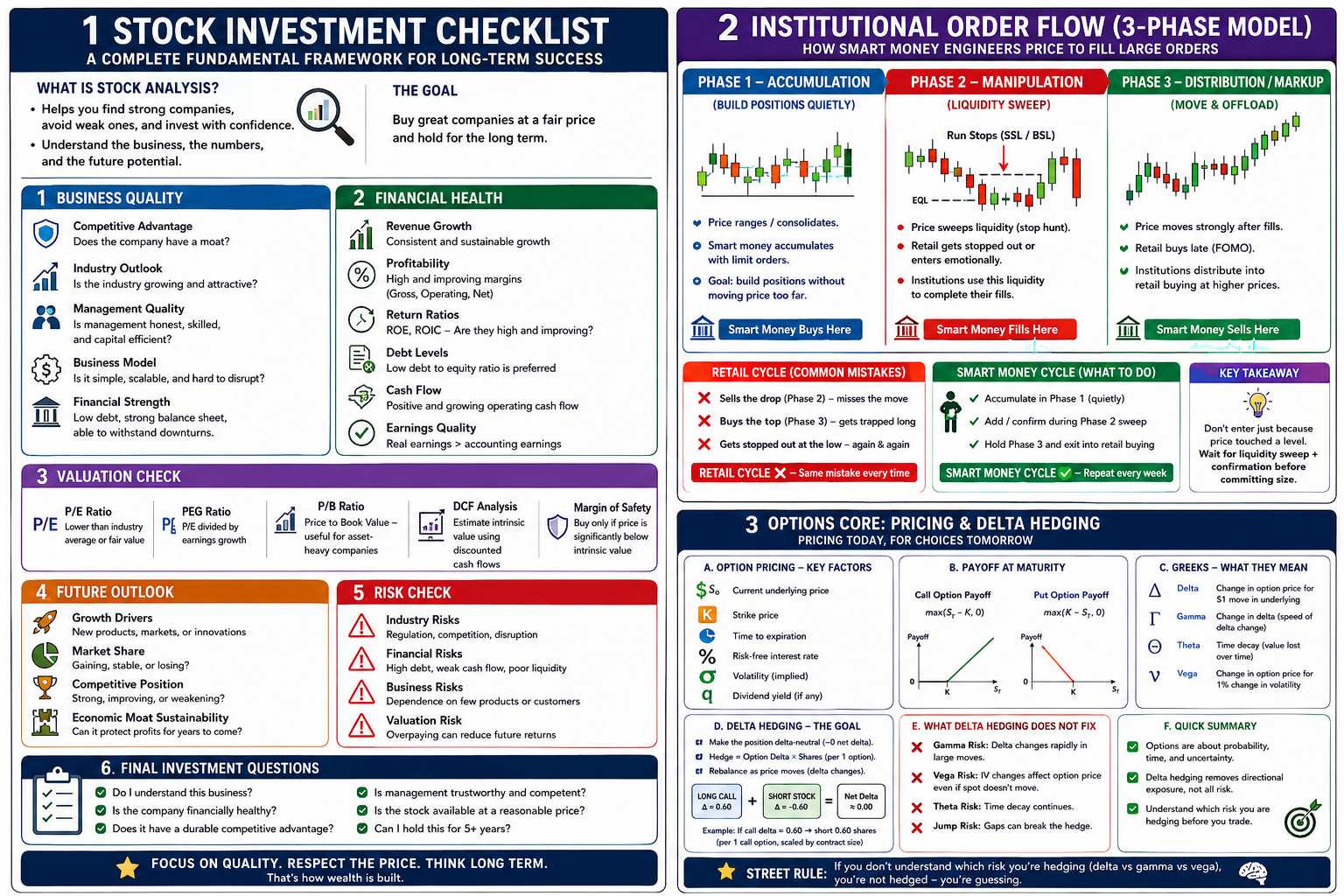
Core Trading Reference — Stock Investment Checklist, Institutional Order Flow, Options Pricing & Delta Hedging
① Stock Investment Checklist  ·  ② Institutional Order Flow — 3-Phase Model  ·  ③ Options Pricing + Delta Hedging
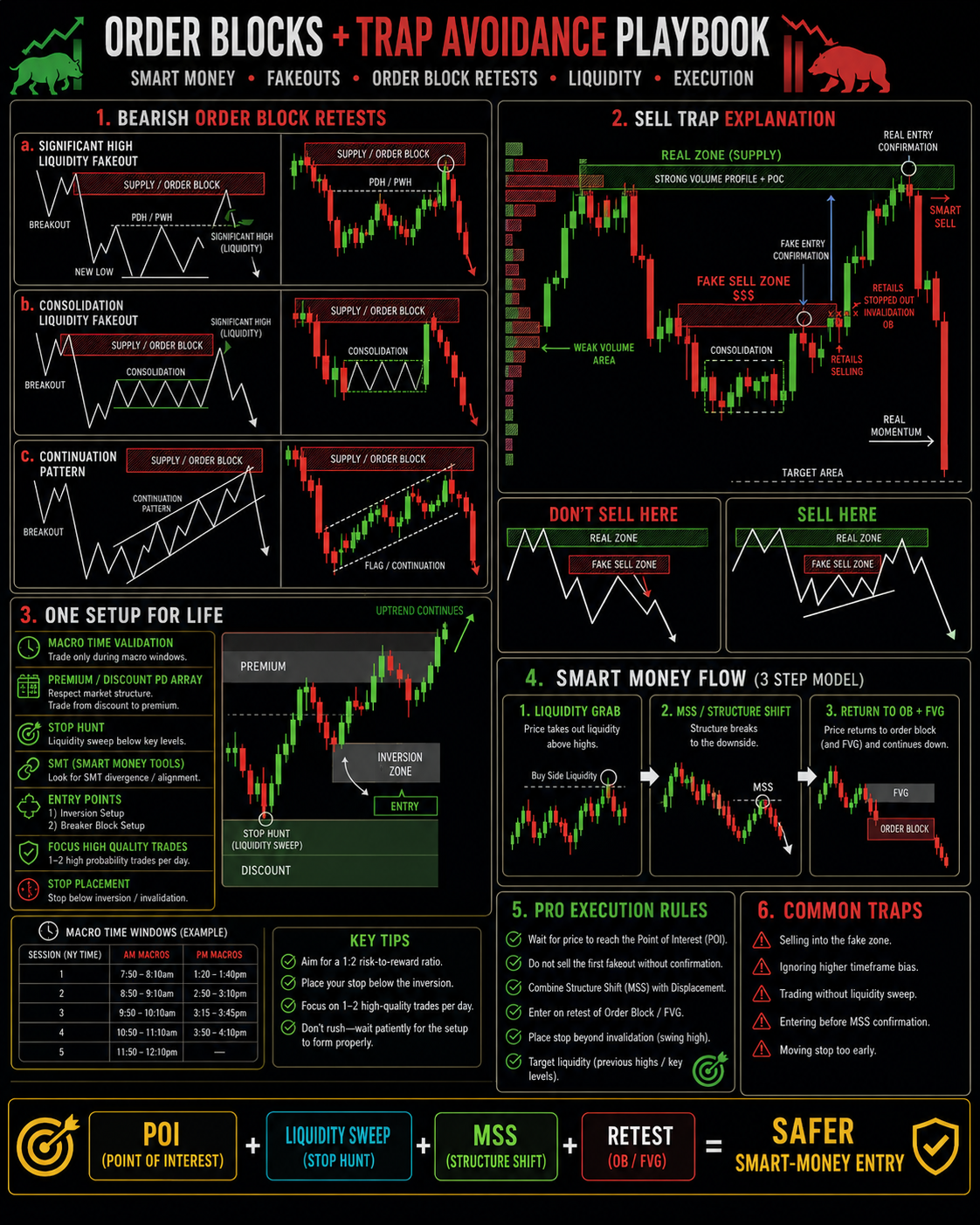
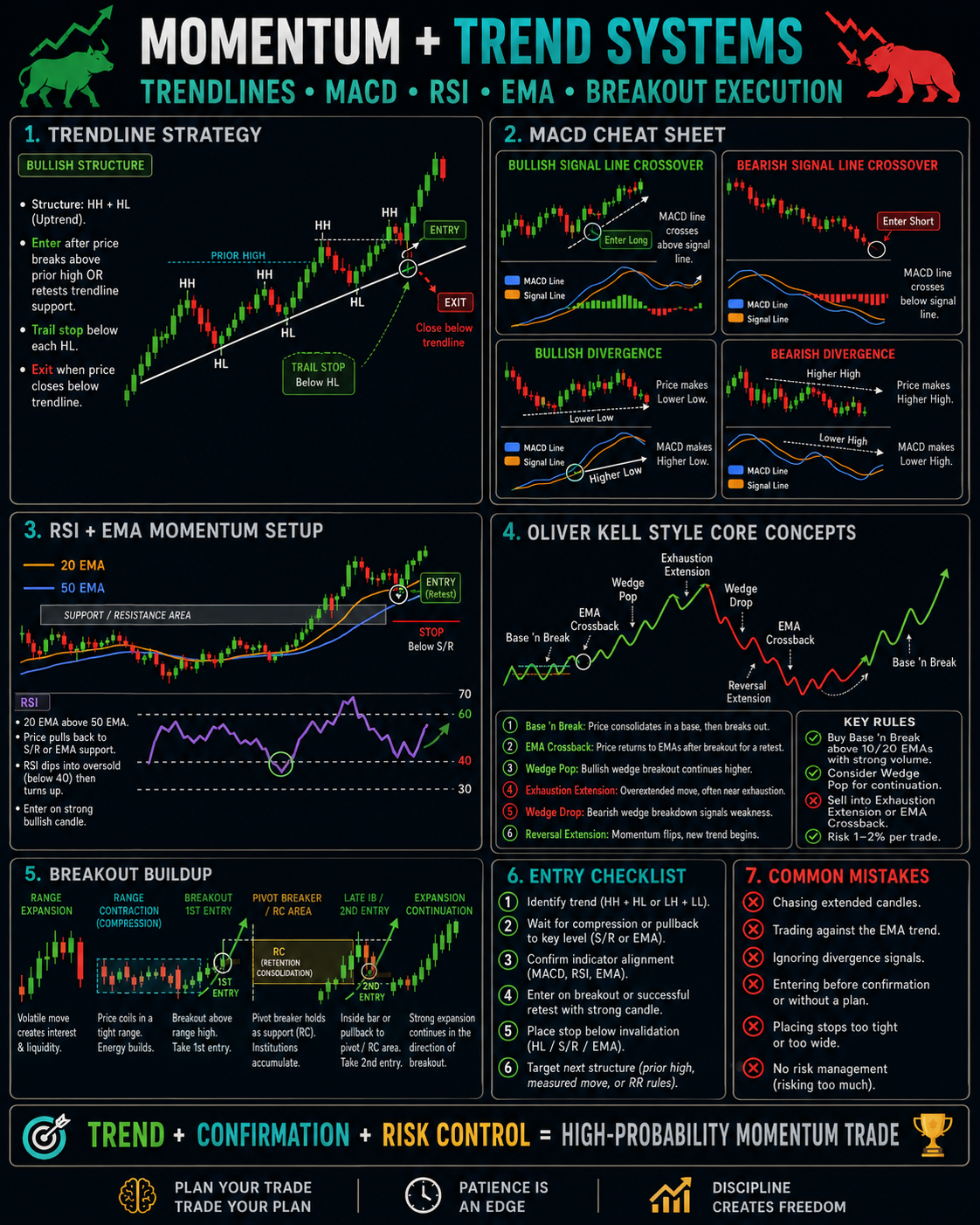
Smart Money & Execution Playbooks

Three core execution frameworks — smart money structure, momentum systems, and order block trap avoidance. Study all three before entering any higher-timeframe trade.
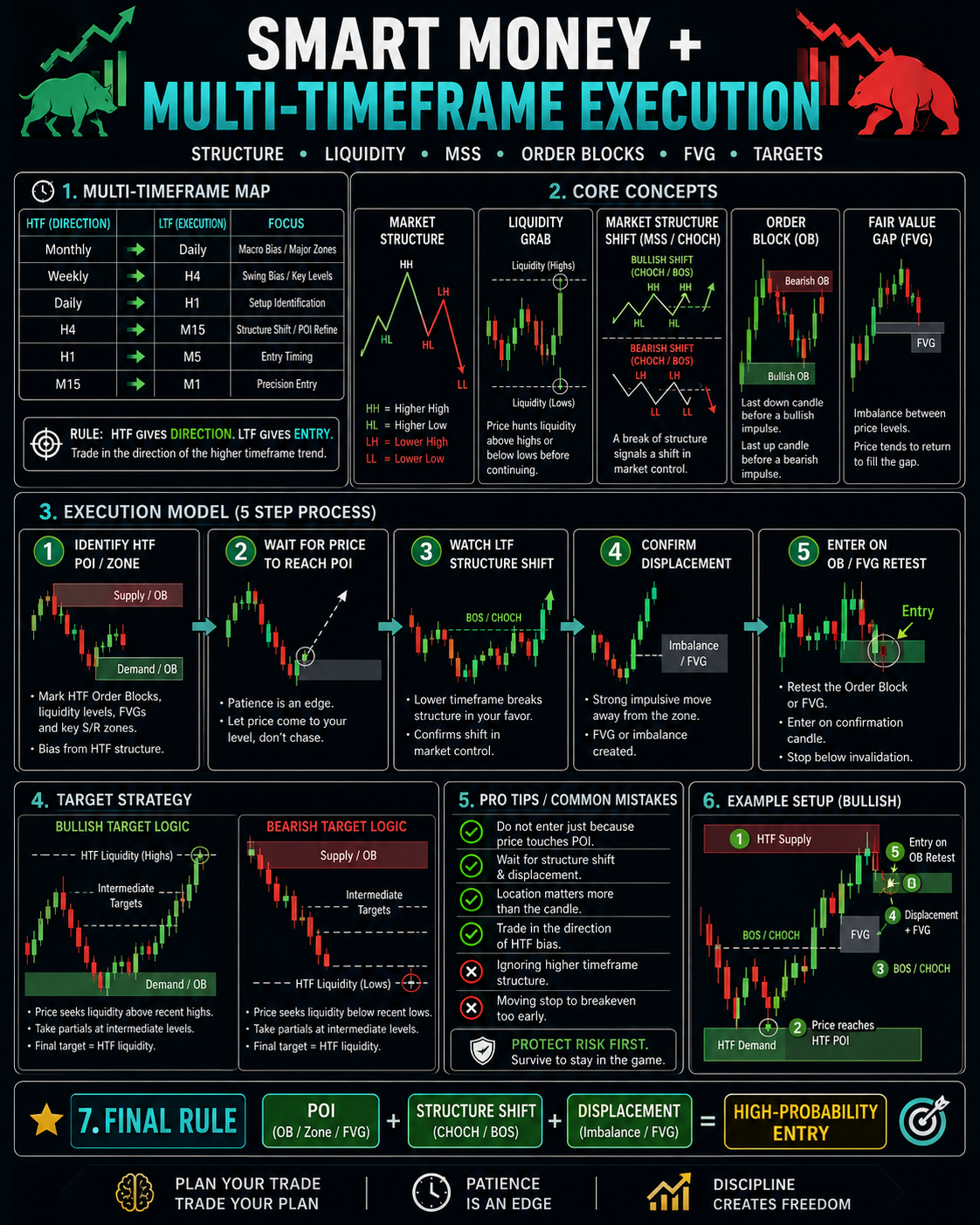
Smart Money + Multi-Timeframe Execution — HTF/LTF structure, liquidity, order blocks, FVG, MSS/CHoCH
Smart Money + Multi-Timeframe Execution — HTF direction · LTF entry · Order Blocks · FVG · MSS/CHoCH
Momentum + Trend Systems — Trendlines, MACD, RSI, EMA, breakout execution
Momentum + Trend Systems — Trendlines · MACD · RSI · EMA · Breakout Execution
Order Blocks + Trap Avoidance Playbook — liquidity fakeouts, smart money flow, OB retests
Order Blocks + Trap Avoidance — Bearish OB Retests · Liquidity Fakeouts · Smart Money Flow
Research / Strategy Calculator
Strategy Calc
Load a clean option chain, verify quote quality, then click a contract row to fill the calculator. The panel flags stale imports, ticker mismatches, zero-bid rows, and weak liquidity before the P&L table gets involved.
Pick Your Strategy
Live Options Chain
How to get your free Tradier API token
1
Open Tradier developer portal
Go to developer.tradier.com in a new tab. This is Tradier's free developer hub — no credit card, no broker account required for sandbox access.
2
Create a free account
Click Register or Sign Up in the top right. Enter your email and a password. Confirm your email — check your inbox for a verification link and click it.
3
Navigate to API Access
After logging in, click your username in the top right corner. In the dropdown select API Access. This opens your token management page.
4
Create a Sandbox Token
Under the Sandbox section click Create Token. A long string of letters and numbers appears — this is your sandbox token. Click Copy or highlight it and copy manually. It looks like: Bearer eyJhbGciOiJ...
5
Paste it below and save
Paste your token into the field below and click Save Token. It saves only in this browser's localStorage — never transmitted anywhere except directly to Tradier's servers when you press Fetch or Scan. You only do this once per browser.
What is the sandbox? Tradier's sandbox uses delayed market data (15-20 mins) — same data you'd see on most free screeners. It's 100% free, has no trade limits, and no broker account is needed. The sandbox token is what powers all live chain pulls, CSP finder, and Income Scanner pulls in this journal.
Token is stored in your browser only. To reset it later: go to Strategy Calc → click Change Token.
Select a strategy above to get started.
Trade Type
Options
Strategy
Long Call
Order Style
Single-leg debit
Robinhood
Reviewed option ticket
Trade Inputs
Pre-fills ticker, strategy, strike, premium, and expiration.
Research / Calculator
Trade Calc
Position sizing, risk/reward, and break-even calculator before you place any trade.
Premium Risk Engine
Answer one question cleanly: how many contracts can I buy without breaking my risk rule?
Sizing formula: max contracts = max risk dollars / risk per contract at stop
Ticker
Name the setup
Size
No contract fits
Planned
Optional check
Decision
Need inputs
Config Defaults
Use your saved account size and risk rule, then enter the option premium from the chain.
Position Sizing
⚡ Pull Option Price from Tradier — auto-fills the Ask Price field
How to fill this out: Enter your account value, keep risk at 10% max, then paste the option's ask price from the chain. The calculator tells you how many contracts you can buy without breaking your risk rule. One contract = 100 shares, so a $0.80 premium costs $80 total per contract.
Your total account value right now. Update this whenever your balance changes.
10% means risking no more than $200 on a $2,000 account. Never go above 10% per trade.
Paste the ask price from the options chain. Example: if the chain shows bid $0.75 / ask $0.85, enter 0.85 or your limit price. This is per share — multiply by 100 to get cost per contract.
Your exit rule as a percent. 50 means you exit if the option loses half its value. Example: bought at $0.80, stop triggers at $0.40. Keep this at 50 for small accounts.
How much gain before you sell. 80 means you exit near an 80% gain. Example: bought $0.80, target sell around $1.44. 80% is the recommended scalp target.
Enter the number of contracts you're considering. The calculator checks if that plan fits inside your risk rules and shows total cost and risk for that specific size.
Max Risk $
Max Contracts
Risk / Contract
Capital Needed
Target Premium
Stop Premium
Target Profit
Planned Risk
Spread Calculator
⚡ Pull Spread Legs from Tradier — fills both strikes, bid/ask, and width automatically
How to fill this out: A spread means you buy one option and sell another. Enter the ask price of the option you're buying, the bid price of the option you're selling, the distance in dollars between the two strikes, and how many contracts. Example: WEN $7.50/$10 call spread — buy the $7.50 call (ask $0.80), sell the $10 call (bid $0.35), width is $2.50.
The ask price from the chain for the call or put you're buying. Example: $7.50 call at ask $0.80 → enter 0.80
The bid price from the chain for the call or put you're selling. Example: $10 call at bid $0.35 → enter 0.35
The dollar difference between your two strikes. Example: $7.50 and $10 strikes → enter 2.50. This is your max possible gain before subtracting the debit paid.
How many spreads you plan to buy. Start with 1-2 in Phase 1. Each contract covers 100 shares so costs multiply fast.
Net Debit (what you pay)
buy ask − sell bid × 100 × contracts
Max Gain (if stock hits top strike)
width − debit × 100 × contracts
Max Loss (if wrong)
total debit paid — capped and defined
R:R Ratio
gain ÷ loss — aim for 1.5x or better
Research / Income Strategy
Cash Secured Put
Sell a put, collect premium upfront, and be willing to buy 100 shares at the strike if assigned. Level 3 required on Ally.

Strategy Overview What Is a CSP?

You sell a put option and keep enough cash in the account to buy 100 shares if assigned. You are saying: "I am willing to buy this stock at this strike price, and I want to get paid premium upfront."
You collect: Premium upfront — yours to keep regardless.
You risk: Being assigned and forced to buy 100 shares at the strike.
Best used on: Stocks you actually want to own at a lower price.
Never use on: Stocks you do not want to own, earnings landmines.

Live Example BAX Case Study

You Sell
$17.50 Put
1 contract · 30 days out
Premium Collected
$45
$0.45 × 100 shares
Cash Required
$1,750
$17.50 × 100 shares
Effective Buy Price
$17.05
$17.50 − $0.45 premium
Outcome 1 — Stock > Strike: Put expires worthless. You keep the $45 premium.
Outcome 2 — Stock < Strike: Assigned. Real cost basis is $17.05 after premium.
Order Ticket Setup
Trade Type
Options
Strategy
Single Leg
Action
Sell to Open
Option Type
PUT
Quantity
1 contract
Expiration
30–45 days out
Strike
Price you want to own
Order Type
Limit
Limit Price
Near mid premium
Critical: The action is Sell to Open Put — not buy, not call, not sell to close. This is the only correct combination.
Key Formulas
Cash Required
Strike × 100 × Contracts

1 put at $10 strike = $1,000
2 puts at $10 strike = $2,000
Max Profit
Premium received × 100

Sell at $0.50 = $50 max profit
Profit if stock stays above strike
Breakeven
Strike − Premium received

$10 strike − $0.50 = $9.50
Stock must stay above $9.50
Max Loss
Breakeven × 100

$9.50 × 100 = $950
If stock goes to zero (worst case)
Choosing Strike & Expiration
Strike Selection
Pick a strike below current price near support.
Ask: would I be happy owning 100 shares here?
Target delta: 20–35 — decent premium without being too aggressive.
Not so far OTM that premium is worthless.
Not so close that you get assigned immediately.
Expiration Selection
Sweet spot: 30–45 days to expiration.
Better premium than weeklies.
More time value — slower theta decay.
Easier to manage than weekly gambling.
Avoid 1-3 day puts unless you understand assignment risk.
Never Sell CSPs On
Penny stocks or stocks under $5.
Stocks you do not want to own.
Biotech with binary FDA events.
Earnings landmines unless intentional.
Wide bid/ask spreads — illiquid chains.
Assignment on any of these = account damage.
CSP Quick Calculator
⚡ Find Best CSP from Tradier — auto-finds 0.25 delta put at 30-45 DTE and fills all fields instantly
Auto-fill workflow: Enter a ticker above, then press Enter or leave the ticker field. Tradier will pick a liquid 0.20-0.35 delta put with a real bid and fill the strike, premium, contracts, and stock price. After it fills, adjust any field manually if your broker gives a better limit price.
The strike price of the put you're selling. This is the price at which you'd be forced to buy 100 shares per contract. Pick a strike where you'd actually be happy owning the stock.
Use the bid price from the chain — that's what you actually receive when selling. Example: bid $0.40 / ask $0.50 → you collect around $0.40-$0.45 depending on your limit. Enter your expected fill.
How many puts you're selling. Start with 1. Each contract requires strike × 100 in cash. 2 contracts = 2× the cash requirement and 2× the assignment risk.
What the stock is trading at right now. Used to calculate how far below the current price your strike is — your safety cushion before you'd get assigned.
Cash Required
must have this before placing trade
Max Profit
if stock stays above strike at expiry
Breakeven
effective buy price if assigned
Safety Cushion
how far stock can fall before you're assigned. 10%+ is safer.
Pre-Trade Checklist — Answer All 7
Do I actually want to own 100 shares of this stock?
Can I afford assignment? Do I have strike × 100 × contracts in cash?
Is the strike near a support level on the chart?
Is the bid/ask spread tight — under 20% of mid?
Is there enough open interest and volume at this strike?
Is earnings before expiration? If yes — is that intentional?
Is the premium worth the risk — at least $0.20+ per contract?
Clean Beginner Example
Stock Price
$10.50
You are okay owning it at $10
You Sell
$10 Put · 30 days
Premium Collected
$40
$0.40 × 100
Cash Required
$1,000
$10 × 100
Breakeven
$9.60
$10 − $0.40
Good outcome: Stock stays above $10 at expiration. Put expires worthless. You keep $40. Done.
Acceptable outcome: Stock drops below $10. You buy 100 shares at $10. Effective cost basis is $9.60. You now own the shares and can hold or sell covered calls.
Pre-fills ticker, type, strike, premium, and breakeven stop.
Income Engine / Put Credit Scanner
Put Credit Scanner
Start with the live Tradier scan, load the best put credit candidate into Spread Builder, verify the risk math, then log or alert from the same page.
1 ScanEnter tickers or use your saved watchlist to pull live chains.
2 LoadClick Use This, or let the best PCS candidate auto-fill the builder.
3 ReviewCheck credit %, cushion, max loss, phase fit, and exit levels.
4 ActLog the spread, send an alert, or refine the strikes before entry.
Live Tradier Candidate Scanner
Long option tuning: these gates rank usable debit calls ahead of cheap slow bleeds. Spread, volume, OI, delta, DTE, and theta burn are hard checks; decay, gamma, vega, and liquidity shape the quality score.

Put Credit mode fills the Spread Builder and PCS log fields. Call modes route to Strategy Calc.

No live candidate loaded yet. The example builder is ready below.
Saved Watchlist
TradeOps Lead Engine
Lightweight Cascade Queue
Ranks current scanner results with deterministic TradeOps gates first. Local AI only explains the queue after the math is locked.
Layer 1
Rules
Score, reject, and rank from scanner facts.
Layer 2
Cascade
Small local models explain without changing math.
Blocked
Drift
No invented prices, earnings, Greeks, or fills.
Run a scan, then rank leads. If no scan exists, selected watchlist tickers are queued as research placeholders.
Weekly Income Targets
$100-200
Ally Weekly Target
$50-150
Fidelity Weekly Target
21 DTE
Target Expiration
0.20-0.30
Short Option Delta
$0.30+
Min Credit per Spread
50%
Take Profit Target
Scanner Mode Guide
Bull Put Credit Mode
Directional fitNeutral to bullish
Short strikeBelow price and below chart support
ProtectionBuy the lower put in the same expiration
ThreatBreakdown through support
Long Call Mode
Directional fitBullish with catalyst or trigger
ContractOne call with liquid bid and ask
Sweet spotTune Delta 0.25-0.60, 14-45 DTE, and theta burn
LoadsLong Call Strategy Calc inputs
Bull Call Spread Mode
Directional fitBullish with defined debit risk
PairingBuy lower call, sell higher call
Debit testDebit should fit spread width
LoadsBull Call Spread Strategy Calc inputs
Spread Builder
Loaded Spread
Example put credit spread ready
Scan a ticker or click Use This to replace the example with live strikes.
How to fill this out: A put credit spread means you sell an OTM put (collect premium) and buy a cheaper put lower down (your protection). Enter the stock price, your two strikes, and the net credit you'd collect for the whole spread as one order. Example: SPY at $450 → sell $440 put (bid $0.60), buy $435 put (ask $0.25), net credit ≈ $0.35.
What the underlying stock or ETF is trading at right now. Used to calculate the safety cushion — how far the stock must drop before you take a loss.
The higher strike put you're selling. This is where your income comes from. Should be 0.20-0.30 delta, below a clear support level. If stock closes above this at expiry, you keep all the credit.
The lower strike put you're buying as protection. This caps your max loss at the spread width. Typically $2-$5 below your short put. Without this, you'd have unlimited risk — this makes it defined.
The net credit for the whole spread as one order. On your broker, set it as a credit limit order. Example: sell $0.60, buy $0.25, net credit ≈ $0.35 per share × 100 = $35 per contract. Minimum $0.30 to trade.
How many spreads you're placing. Each contract = 100 shares. Start with 1-2. Maximum 3 on any single name per your income rules.
Days to expiration when you enter. Target 21 days. Close at 50% profit (usually 7-10 days in). Never hold to expiration chasing the last few dollars.
Delta of the put you are selling from your broker chain (0.20-0.30 range). Used to estimate Probability of Profit (≈ 1 − delta). Leave blank to skip.
Implied volatility of the short put from your broker chain (e.g. 35 for 35%). Unlocks expected move, σ distance, lognormal PoP, and expected value. Leave blank to skip.
Max Profit
If expires worthless
Max Loss
If stock hits long strike
Breakeven
Short strike − credit
50% Profit Target
Close here — take the win
Cushion from Stock
Stock must drop this far
Credit % of Width
Min 20-25% to trade
Pre-fills strikes, credit, and DTE.
Fidelity Scanner Parameters
Scanner A — Bull Put Candidates
Security Price$15 to $150
% Price Change Today-1% to +8%
Price Performance 5 Daysminimum -2%
Price Performance 13 Wksminimum 0% — not in freefall
Volume 90 Day Avg2M or above
OptionableYes — weekly options preferred
Beta 1 Yearunder 3.0 — not too wild
Earnings AnnouncementsNOT within 21 days
Security TypeCommon Stock or ETF
Scanner B — ETF Income Plays
Security TypeETF only
Security Price$20 to $600
Volume 90 Day Avg5M or above
OptionableYes
Best ETFs for PCSSPY · QQQ · IWM · GLD · SLV
Why ETFsNo earnings risk · Diversified · Predictable IV cycles
% Price off 50 Day SMA-5% to +15% — near trend
% Price off 200 Day SMAabove -10% — not in crash
Scanner C — High IV Stocks
Use Cboe IV30 vs HV30IV30 - HV30 above +20
WhyHigh IV = rich premium = better credit collected
Security Price$15 to $100
Volume 90 Day Avg2M or above
OptionableYes
EarningsNOT within 21 days
ChartPrice above 50 day SMA — uptrend
Price off 52 Wk Lowabove 20% — not near lows
Cboe LiveVol Cross-Reference
Cboe Scanner 19 — IV30 vs HV30
FilterIV30 significantly above HV30
Minimum gap+20 points IV above HV
Why it mattersYou sell expensive options — IV crush works FOR you
Sweet spotIV30 between 40-80% — rich but not insane
AvoidIV30 above 100% without earnings catalyst — too risky
Cboe Scanner 16 — Bearish Put Flow
Use asFADE signal — not follow signal
LogicIf put flow is heavy but stock holds — premium is elevated = sell puts
Best signalHeavy put buying + stock NOT breaking down = sell puts into fear
AvoidHeavy put buying + stock breaking down = do not sell puts
Cboe Scanner 17 — Bullish Delta
SignalNet positive delta = institutions buying calls
Why usefulBullish institutional flow = safe to sell puts below market
ConfirmationBull delta + IV elevated + stock above 50 SMA = A+ PCS setup
AvoidNegative net delta on your underlying — institutions are bearish
Options Chain Requirements
Short Put (Sold Leg)
Delta0.20 to 0.30 — 20-30% OTM
Strike locationBelow key support level on chart
Open Interestminimum 200 contracts
Bid/Ask spreadunder 20% of mid
Bid pricemust NOT be $0.00
IV at strikeelevated vs HV — you want rich premium
Long Put (Protection Leg)
Delta0.10 to 0.15 — further OTM
Width from short put$2 to $5 — your max loss zone
Same expirationMust match short put expiry exactly
Open Interestminimum 100 contracts
PurposeCaps your max loss — makes this defined risk
The Spread as a Unit
Net credit minimum$0.30 per spread ($30 per contract)
Credit % of widthminimum 20-25% of spread width
DTE at entry21 days — your target
Take profit at50% of credit collected
Stop loss at200% of credit (2x what you collected)
Order typeNet credit limit — never market
Auto-Reject — Never Sell PCS On
Earnings within 21 daysInstant reject — gap risk is unlimited
Stock in downtrendPrice below 50 SMA and falling
Credit under $0.20Not worth the margin requirement
IV below HVCheap options = unfavorable to sellers
Wide bid/askOver 30% of mid = execution risk
OI under 100Illiquid = can't close when needed
Biotech / FDA eventsBinary risk — stock can gap 50%+
Best Underlyings for Weekly PCS Income
Tier 1 — ETFs (Lowest Risk)
SPYS&P 500 — most liquid options on earth
QQQNasdaq 100 — tech sector proxy
IWMRussell 2000 — higher IV than SPY
GLDGold ETF — good in uncertain markets
XLFFinancials sector ETF
WhyNo earnings risk · Predictable · Institutional liquidity
Tier 2 — Large Cap Stocks
AAPLWatch earnings dates carefully
MSFTStable trend — good support levels
NVDAHigher IV = more premium but more risk
AMZNLarge cap — predictable support zones
RuleAlways verify earnings NOT within 21 days
Strike guide3-7% below current price for 0.25 delta put
Tier 3 — Scanner-Found Plays
SourceFidelity Scanner A or B — hits only
Must cross2+ Fidelity scanners + Cboe IV30 elevated
Stock trendPrice above 50 SMA — confirmed uptrend
Earnings checkMandatory — must be clear for 21+ days
Support levelStrike must be below identifiable support
Max position size3 contracts maximum on any single play
Weekly PCS Workflow
Monday 9:15am: Run all 3 Fidelity scanners + Cboe IV30 vs HV30. Build your candidate list for the week. Check that no candidates have earnings within 21 days.
Monday-Tuesday Open: Pull up the chain on top 3 candidates. Confirm IV30 above HV30. Find your 0.20-0.30 delta short put. Verify support level below strike. Check OI and spread width.
Entry — Place the spread: Sell the 0.25 delta put. Buy the put $2-5 lower for protection. Set net credit limit order — never market. Target minimum $0.30 credit per spread. Log it in the PCS Trade Log immediately.
Mid-week management: Check positions once per day max. If spread is at 50% profit — close it and take the win. Do not hold to expiration chasing the last few dollars.
Stop loss rule: If spread reaches 200% of credit (you paid 2x what you collected to close) — close immediately. Example: collected $0.50, stop loss triggers at $1.00 debit to close.
Pre-Entry Checklist
Stock confirmed on 2+ Fidelity scanners OR is a Tier 1 ETF
IV30 is above HV30 — confirmed on Cboe scanner 19
No earnings within 21 days — verified on earnings calendar
Stock is above its 50-day SMA — uptrend confirmed
Short put strike is below a clear support level on the chart
Short put delta is between 0.20 and 0.30
OI at both strikes is minimum 200 contracts
Bid/Ask spread is under 20% of mid on both legs
Net credit is minimum $0.30 per spread ($30 per contract)
Credit is at least 20% of the spread width
DTE is 18-24 days — targeting your 21 DTE sweet spot
Take profit order set at 50% of credit immediately after entry
Portfolio Compounder
Income Engine / PCS Trade Log
PCS Trade Log
Track every put credit spread separately from your directional trades. Weekly income is its own system.
Total Collected
$0
All time
Open Positions
0
Active spreads
This Week
$0
Realized income
Win Rate
Expired worthless
Avg Credit
Per spread
Ally Target
$150
$100-200 weekly
Fidelity Target
$100
$50-150 weekly
Log New PCS Trade
⚡ Pull PCS Entry from Tradier — finds a 0.20-0.30 delta short put, protection leg, live credit, DTE, IV, and stock price
AI Pick Inbox
Saved AI Picks
PickStrategySpreadCreditScoreExpirySafetyEarningsRead / Risk
No AI picks saved yet
Monthly Income
No trades yet
Active & Recent Spreads
FILTER:
TickerAccountSpreadCreditQtyTotal $50% TargetStopExpiryDTEIV EdgeStatusClose $P&L
No PCS trades logged yet
Income Engine / SMC Bias
SMC Bias Check
Pulls 90 days of OHLC from Tradier and algorithmically scores swing structure, BOS, MSS, liquidity sweeps, active FVGs, and trend filters. Use this to confirm directional bias before running any scanner.
Ticker Analysis
QUICK CHECK
SMC Bias Chart — TradingView
Chart loads from the SMC ticker box above.
Enter a ticker and click Check Bias, or load the chart manually.
What Gets Checked
Structure
Higher HighsEach swing high above previous
Higher LowsEach swing low above previous
BOSClose above last confirmed swing high
MSSFirst bullish BOS after bearish structure
Liquidity & FVG
SweepWick past swing level → close back inside
FVG3-candle imbalance — candle 3 gap vs candle 1
Active FVGGap not yet filled by subsequent price action
FVG SupportActive bull FVG within 3% below current price
Trend Filters
EMA 20Price above = near-term bullish
EMA 50Price above = medium-term bullish
RSI 14Above 50 = bullish momentum
Bias score7+ bull signals = Strong Bullish
Income Engine / Lev ETF Scanner
Leveraged ETF Scanner
Score leveraged ETFs on net assets, daily momentum, optionability, and premium/discount. Routes each fund into OPTIONS READY → CHAIN CHECK → WATCHLIST ONLY → DO NOT TRADE before you waste time on a garbage chain.
Add ETF to Scanner
Advanced / Override
AI ETF Search
Filter
ETF Chart — TradingView
TradingView — auto-loads on known ETF
Type a ticker above — chart auto-loads on known ETFs.
Income ETF Scanner — Roundhill WeeklyPay™ & 0DTE
⚠ Distribution yields are annualized estimates from Roundhill. Many distributions include Return of Capital (ROC) — check 19a-1 notices before investing.
WeeklyPay™ Income Calculator
Income Power Example — NVDW
NVDW: Roundhill NVDA WeeklyPay ETF targets weekly distributions and 120% of NVDA's calendar-week total return before fees and expenses. A $25,000 income sleeve at a 54% annualized distribution assumption equals about $1,125/month before taxes, price movement, and distribution changes. Use this as a scenario tool, not a promise: the fund fact sheet says distributions are expected but not guaranteed and may include return of capital.
Cash alternative lens: compare idle cash against weekly distribution potential, but only after checking NAV trend, drawdown, and whether payouts are return of capital.
Double engine idea: distributions create base income; listed options may create covered-call or hedge opportunities only if the chain is liquid enough.
Risk rule: this belongs in a capped income sleeve, not the whole account. Recheck yield, NAV, NVDA trend, expense ratio, and 19a-1 distribution notices weekly.
Strategy Router Rules
Step 1 — ETF Quality Gate
Above $1B AUMInstitutional quality — options ready
$500M–$1BStrong — check chain before entry
$100M–$500MUsable — chain must be verified
Under $50MWatchlist only unless chain exceptional
Step 2 — Direction
Bull ETF moving upBullish momentum candidate
Bull ETF breaking downBearish put/debit spread candidate
Inverse ETF moving upBearish-market signal
Inverse ETF breaking downAvoid — no confirmed reversal
Step 3 — Strategy Match
Strong bull + tight chainLong Call
Strong bull + expensive IVBull Call Debit Spread
Pullback + elevated IVPut Credit Spread
Breakdown below MAsLong Put or Bear Put Spread
Extended moveWatchlist only — avoid chase
Step 4 — Chain Requirements
Bid/ask spreadUnder 10% of mid
Option volumeAbove 100
Open interestAbove 500
Delta (long)0.25 – 0.60
Theta burnUnder 5%/day unless scalping
Research / Strategy Reference
Strategy Definitions
All options strategies, custom multi-leg structures, SMC price action terms, and a full options glossary. Search by name or filter by direction and risk type. Click any card to open in Calculator.
Lead Intelligence
High-Conviction Setups
Scanning for high-conviction opportunities...
View Full Research Queue →
Basic Strategies
Long Call
Level 1
Bullish

You buy one call option and pay a premium upfront. This gives you the right to buy 100 shares at the strike price before expiration. If the stock rises above your break-even (strike + premium paid) you profit. If it does not move enough you lose the entire premium. This is the core directional trade for your challenge — every scanner hit that has a catalyst goes here first.

Max Profit
Unlimited
Max Loss
Premium paid
Break-even
Strike + premium
When to use: Stock confirmed bullish on 2+ scanners. Catalyst within DTE. IV30 above HV30. Delta 0.25-0.60. OI 500+. Volume 100+. Non-zero bid. Your phase 1 go-to trade.
Long Put
Level 1
Bearish

You buy one put option and pay premium upfront. This gives you the right to sell 100 shares at the strike price before expiration. Profit when the stock falls below your break-even (strike minus premium paid). If the stock stays flat or rises you lose the entire premium. Mirror image of a long call but for downside moves.

Max Profit
Strike goes to zero
Max Loss
Premium paid
Break-even
Strike − premium
When to use: Downtrend confirmed on scanner. Bearish dark pool prints. Put flow anomaly scan hit. Stock below 50 SMA and failing bounces. Delta −0.25 to −0.50.
Covered Call
Level 1
Income · Neutral

You already own 100 shares of a stock and you sell one call option against those shares. You collect the premium immediately. If the stock stays below the strike at expiration you keep the premium and the shares. If it rises above the strike your shares get called away at the strike price — you still profit but miss further upside. Generates income from shares you hold.

Max Profit
Premium + gains to strike
Max Loss
Stock falling to zero
Break-even
Share cost − premium
When to use: You own 100 shares and want to generate income. Neutral to slightly bullish outlook. Sell strike above current price where you'd be OK selling shares. Avoid before earnings.
Cash Secured Put
Level 2
Income · Bullish

You sell a put option and keep cash equal to strike × 100 in your account. You collect the premium. If the stock stays above the strike you keep the premium — trade is done. If it falls below you get assigned and must buy 100 shares at the strike price. Your effective buy price is the strike minus the premium collected. Only use on stocks you genuinely want to own.

Max Profit
Premium collected
Max Loss
Stock crashes to zero
Break-even
Strike − premium
When to use: Bullish on a stock. Want to buy it at a discount OR collect premium if it stays flat. 20-35 delta puts. 30-45 DTE. Never use on stocks you do not want to own. Cash required = strike × 100.
Naked Call
Level 3 ⚠
AVOID — Unlimited Risk

You sell a call option without owning the underlying shares. You collect the premium. If the stock rises above the strike you must buy shares at market price and sell at the strike — your loss is theoretically unlimited because a stock can rise infinitely. This is the most dangerous options strategy.

Max Profit
Premium collected
Max Loss
UNLIMITED
Break-even
Strike + premium
When to use: Do NOT use this strategy in your small account challenge. Unlimited upside risk can wipe your entire account and then some. Not appropriate for Phase 1-4.
Naked Put
Level 2
Bullish · Income

You sell a put option without holding the full cash to cover assignment. Similar to a cash secured put but uses margin instead of cash. You collect premium and profit if the stock stays above the strike. If assigned you must buy 100 shares using margin. Higher capital efficiency but requires margin account.

Max Profit
Premium collected
Max Loss
Stock goes to zero
Break-even
Strike − premium
When to use: Bullish. High IV. Comfortable with margin. Prefer cash secured put version for your account. Only use naked puts on stocks you are fully prepared to own at the strike price.
Spreads
Credit Spread
Level 2
Income · Defined Risk

You sell one option and buy another option further out of the money for protection. You collect a net credit upfront. The short option decays and you keep the credit if the stock stays away from your short strike. Can be a bull put credit spread (bullish) or a bear call credit spread (bearish). Your primary weekly income strategy — the PCS Engine in your journal.

Max Profit
Net credit received
Max Loss
Width − credit
Break-even
Short strike ± credit
When to use: Your 21 DTE weekly income system. Sell 0.25 delta put, buy protection $2-5 lower. Collect minimum $0.30 credit. Close at 50% profit. Stop at 200% of credit. Ally target $100-200/week. Fidelity target $50-150/week.
Call Spread
Level 2
Bullish · Defined Risk

You buy a lower strike call and sell a higher strike call at the same expiration. You pay a net debit. You profit if the stock rises above your break-even and caps out at the width of the spread minus what you paid. Also called a bull call spread or vertical call spread. Defined risk version of buying a long call — cheaper entry and capped loss.

Max Profit
Width − debit paid
Max Loss
Debit paid
Break-even
Lower strike + debit
When to use: Bullish confirmed setup. Want defined risk. Your WEN $7.50/$10 May 29 trade was this exact structure. Phase 1-2 primary trade. Target net debit under 30% of spread width. Limit orders only — never pay ask.
Put Spread
Level 2
Bearish · Defined Risk

You buy a higher strike put and sell a lower strike put at the same expiration. You pay a net debit. You profit if the stock falls below your break-even. Also called a bear put spread or vertical put spread. Capped profit and capped loss. The bearish equivalent of a call spread — same mechanics, opposite direction.

Max Profit
Width − debit paid
Max Loss
Debit paid
Break-even
Higher strike − debit
When to use: Bearish scanner confirmation. Downtrend confirmed. Put flow anomaly hit. Stock below 50 SMA. Same rules as call spread — defined risk, limit orders, no chasing.
Poor Man's Covered Call
Level 2
Neutral · Income

Instead of owning 100 shares and selling a covered call, you buy a deep in-the-money long-dated call option (a LEAP — typically 6-12 months out) and sell shorter-dated out-of-the-money calls against it every week or month. The LEAP acts as your share substitute. Much cheaper than owning 100 shares. You collect premium repeatedly from the short calls.

Max Profit
Repeated short call premium
Max Loss
LEAP cost if stock crashes
Break-even
LEAP cost − premiums collected
When to use: Want covered call income but cannot afford 100 shares. Buy 0.80+ delta call 6+ months out. Sell 0.30 delta call 30-45 days out. Good for expensive stocks like NVDA or MSFT.
Calendar Spread
Level 2
Neutral · Time Play

You buy a longer-dated option at a strike and sell a shorter-dated option at the same strike. You pay a net debit. You profit from the difference in time decay between the two expirations — the short option decays faster than the long. Profits most when the stock stays near the strike and IV expands.

Max Profit
IV expansion + decay diff
Max Loss
Debit paid
Break-even
Near the strike
When to use: Stock expected to pin near a price short-term. IV expected to rise. Pre-announcement setups. Not ideal when you expect a big directional move.
Ratio Back Spread
Level 3
Advanced

You sell one at-the-money option and buy two or more out-of-the-money options in the same direction. The result is a position that profits from a large explosive move while having limited or no risk if the stock stays flat. Complex to manage and requires precise execution.

Max Profit
Large explosive move
Max Loss
Stock pins at short strike
Break-even
Two break-even points
When to use: Expecting a massive binary move. Biotech FDA events. Earnings gambles. Not recommended for Phase 1-3.
Advanced Strategies
Iron Condor
Level 3
Income · Neutral · Defined

You sell an out-of-the-money call spread AND an out-of-the-money put spread simultaneously on the same underlying and expiration. You collect credit from both sides. You profit if the stock stays inside the range between your two short strikes at expiration. Four legs total.

Max Profit
Total credit from both spreads
Max Loss
Width − total credit
Break-even
Two break-even points
When to use: Stock expected to stay range-bound. High IV environment. Post-earnings fades. ETF income plays on SPY, QQQ, IWM. Close at 50% profit. Cut at 200% loss on either side.
Butterfly
Level 2
Neutral · Defined

You buy one lower strike option, sell two middle strike options, and buy one higher strike option — all at the same expiration. The middle strike is equidistant from both outer strikes. You pay a small net debit. Maximum profit occurs when the stock pins exactly at the middle strike at expiration.

Max Profit
Stock pins middle strike
Max Loss
Small debit paid
Break-even
Two break-even points
When to use: You expect the stock to settle near a specific price at expiration. Post-earnings when you have a precise price target. Small debit risk makes this a lower-risk advanced play.
Collar
Level 1
Protective · Neutral

You own 100 shares, buy an out-of-the-money put for downside protection, and sell an out-of-the-money call to fund the put cost. The short call caps your upside gain. The long put limits your downside loss. The two options can offset each other in cost — a zero-cost collar means the premium from the call equals the cost of the put.

Max Profit
Call strike − share price
Max Loss
Share price − put strike
Break-even
Share cost ± net premium
When to use: You own shares with large unrealized gains and want to protect them without selling. Lock in a price range. Good protective tool for existing stock positions.
Diagonal Spread
Level 2
Directional · Income

You buy a longer-dated option at one strike and sell a shorter-dated option at a different strike. Both different strikes AND different expirations — that is what makes it diagonal. You profit from the short option decaying faster while the long option retains value.

Max Profit
Short premium decay + direction
Max Loss
Net debit paid
Break-even
Depends on strikes + debit
When to use: Moderately bullish or bearish trending stock. Want to collect premium repeatedly while maintaining directional exposure. Requires active management of short leg rolls.
Double Diagonal
Level 3
Advanced · Complex

Two diagonal spreads placed simultaneously — one bullish diagonal and one bearish diagonal. You buy longer-dated options on both sides and sell shorter-dated options on both sides. Similar to an iron condor but with different expirations on each side.

Max Profit
Both short legs decay
Max Loss
Large move either direction
Break-even
Multiple break-even points
When to use: Advanced income traders only. Not appropriate for Phase 1-4 of your challenge. Requires deep understanding of time spread mechanics.
Straddle
Level 2
Neutral · Volatility Play

You buy both a call AND a put at the same strike price and same expiration. You pay premium for both options. You profit from a large move in either direction — it does not matter which way the stock goes as long as it moves enough to cover both premiums paid.

Max Profit
Unlimited — either direction
Max Loss
Both premiums paid
Break-even
Strike ± total premium
When to use: Expecting a massive move but unsure of direction. Pre-earnings on high IV names. Binary events. Watch for IV crush — buy before IV spikes, not after.
Strangle
Level 2
Neutral · Volatility Play

You buy an out-of-the-money call AND an out-of-the-money put at different strikes but same expiration. Cheaper than a straddle — needs a bigger move than a straddle to profit but costs less upfront. Profit from a large move in either direction.

Max Profit
Large move either direction
Max Loss
Both premiums paid
Break-even
Two outer break-even points
When to use: Pre-earnings on volatile stocks when you expect a big reaction but want cheaper exposure than a straddle. Watch for IV crush — same risk as straddle.
Covered Strangle
Level 2
Income · Bullish

You own 100 shares, sell an out-of-the-money call above the stock price, AND sell an out-of-the-money put below the stock price simultaneously. You collect double premium — from both the call and the put. Bullish bias. If the stock crashes the put gets assigned and you buy more shares at the put strike.

Max Profit
Double premium collected
Max Loss
Stock crash + extra assignment
Break-even
Stock price − total premium
When to use: Strongly bullish on a stock you own. Want maximum premium income. Comfortable being assigned additional shares at the put strike. Only use when you have the cash to cover both assignments.
Synthetic Put
Level 3
Bearish · Advanced

You short 100 shares of stock AND buy an at-the-money call option. This combination replicates the payoff of a long put without actually buying a put directly. Used when put options are expensive and you can borrow shares to short.

Max Profit
Stock falls to zero
Max Loss
Call premium paid
Break-even
Short price − call premium
When to use: Puts are overpriced. You can short the stock. Requires margin account and short approval. Rarely needed for directional small account trading.
Reverse Conversion
Level 3
Institutional · Arbitrage

You are long stock, long a put, and short a call at the same strike — creating a near risk-free position. Used by professional traders and market makers to capture mispricings between options and the underlying stock.

Max Profit
Small arbitrage profit
Max Loss
Minimal if correct
Break-even
Near entry price
When to use: Institutional arbitrage only. Zero practical use for your $500-$10,000 challenge. Do not attempt this strategy.
Custom Multi-Leg
2 Legs
Level 2
Custom · Basic Spreads

Any combination of two individual options. Covers all standard spreads: call spread, put spread, straddle, strangle, risk reversal. Two-leg strategies are the foundation. Every spread you trade in Phase 1-2 is a 2-leg trade.

Max Profit
From filled legs
Max Loss
From filled legs
Break-even
Shown in P&L
When to use: Bull call spread, bear put spread, straddle, strangle, bull put credit spread, bear call credit spread. Your primary trade structure in phases 1 through 3.
3 Legs
Level 2
Custom · Ratio Plays

Three individual option positions combined. Covers ratio spreads (buy one sell two), back spreads (sell one buy two), and broken-wing spreads. Allows asymmetric risk-reward profiles.

Max Profit
From filled legs
Max Loss
From filled legs
Break-even
Shown in P&L
When to use: Ratio call spread (buy 1, sell 2), back spread (sell 1, buy 2), broken wing butterfly. Use when you want asymmetric exposure beyond a standard spread.
4 Legs
Level 2
Custom · Condors & Butterflies

Four individual option positions combined. The iron condor and butterfly are 4-leg strategies. Allows income structures with defined risk on both sides, or precise price target trades.

Max Profit
From filled legs
Max Loss
From filled legs
Break-even
Shown in P&L
When to use: Iron condor (two credit spreads), butterfly (buy-sell-sell-buy), iron butterfly. Your Phase 3-4 income strategy candidates.
5 Legs
Level 3
Custom · Complex Hybrids

Five individual option positions — typically a hybrid between two standard strategies. Rarely used by retail traders. Usually built for a very specific risk-reward profile not achievable with fewer legs.

Max Profit
From filled legs
Max Loss
From filled legs
Break-even
Shown in P&L
When to use: Modified condor with a ratio on one side. Use only when a specific P&L profile cannot be replicated with 4 or fewer legs.
6 Legs
Level 3
Institutional

Six individual option positions. Double butterfly, double calendar, or two condors combined. Execution cost and complexity is very high. Almost never appropriate for retail small account traders.

Max Profit
From filled legs
Max Loss
From filled legs
Break-even
Shown in P&L
When to use: Double butterfly, condor plus calendar. Rarely relevant for accounts under $25,000. Do not use in Phase 1-4.
8 Legs
Level 3
Institutional Only

Eight individual option positions simultaneously. The most complex retail-accessible custom structure. Eight bid-ask spreads to cross means the position needs substantial premium to be worthwhile. Professional territory only.

Max Profit
From filled legs
Max Loss
From filled legs
Break-even
Shown in P&L
When to use: Double iron condor across two expirations. Not relevant for your account size or challenge phase.
SMC / Price Action Terms
BOS
Structure
Break of Structure

Price closes beyond a prior swing high (bullish BOS) or swing low (bearish BOS). Confirms the current trend is intact and institutional momentum is continuing. The SMC checker requires at least one BOS in the past 30 daily bars. A BOS sets the bias context — it is not a trade trigger on its own.

Signal
Continuation
Timeframe
Daily / 4H
Reliability
High
How to use: After a BOS in your intended direction, wait for a pullback into an FVG or Order Block before entering. Never chase the BOS candle directly.
MSS
Structure
Market Structure Shift

Price breaks against the prevailing trend and closes beyond a key swing point in the opposite direction. Bullish MSS: a bearish trend breaks a recent swing high. Bearish MSS: a bullish trend breaks a recent swing low. Stronger than a CHoCH — suggests the trend may be fully reversing, not just pausing.

Signal
Reversal
Timeframe
Daily
Reliability
Medium-High
How to use: After an MSS, wait for a retrace into the MSS zone that holds, then a BOS in the new direction to confirm. The SMC checker scores a point when MSS aligns with the target bias.
CHoCH
Structure
Change of Character

The first signal that a trend may be exhausting before a full reversal is confirmed. Bullish CHoCH: in a downtrend, price makes a higher high for the first time. Bearish CHoCH: in an uptrend, price makes a lower low. Not confirmed until followed by a full MSS. Use as a warning, not a trade trigger.

Signal
Early Warning
Timeframe
Any
Reliability
Medium
How to use: CHoCH alone is not an entry. Tighten stops on existing trades and watch for a follow-through MSS. If the trend resumes without MSS, the CHoCH was a false signal — ignore it.
FVG
Imbalance
Fair Value Gap

A 3-candle imbalance where the wick of candle 1 and the wick of candle 3 do not overlap. Smart money moved price too fast, leaving unfilled orders in the gap. Price tends to retrace into the zone to fill it before continuing the original direction. Bullish FVG = gap below current price. Bearish FVG = gap above.

Signal
Entry Zone
Timeframe
Daily / 4H
Reliability
High
How to use: In an uptrend, find a bullish FVG below price. When price retraces into the zone, enter long at the midpoint or bottom with a stop below the FVG low. The SMC checker lists all active unmitigated FVGs.
IFVG
Imbalance
Inverted Fair Value Gap

A previously bullish FVG that price entered but then closed through, flipping the zone to resistance. Or a bearish FVG that became support. When price closes through an FVG instead of bouncing, the zone is mitigated and inverts. IFVGs signal that institutional intent at that level has reversed and the zone now acts as supply/demand of the opposite type.

Signal
Flip Zone
Timeframe
Daily
Reliability
Medium
How to use: If price enters a bullish FVG but closes below the zone's bottom, treat it as flipped to resistance. Avoid long entries at IFVGs. Use the former FVG bottom as a resistance level on any retest.
HH / HL
Trend
Higher High / Higher Low

The defining structure of a bullish trend. Each rally exceeds the prior peak (HH) and each pullback stays above the prior trough (HL). The SMC checker counts HH+HL occurrences vs LH+LL occurrences in the last 20 bars. Bullish bias requires HH+HL pairs to outnumber LH+LL pairs. A violated HL is the first structural warning of trend failure.

Bias
Bullish
Timeframe
Any
Reliability
Very High
How to use: Count HH/HL pairs on the daily chart. Look for long entries on HL pullbacks, not after HH breakouts. The trend is healthy as long as each HL holds above the prior one. A break of HL signals trend danger.
LH / LL
Trend
Lower High / Lower Low

The defining structure of a bearish trend. Each rally fails below the prior peak (LH) and each drop makes a new trough (LL). The bearish mirror of HH/HL. When LH+LL pairs outnumber HH+HL pairs in the last 20 bars, the SMC checker scores a bearish trend point. A bullish BOS through a prior LH is the first signal a downtrend may be ending.

Bias
Bearish
Timeframe
Any
Reliability
Very High
How to use: In an LH/LL downtrend, look for short entries on LH bounces or after LL breaks. Avoid long trades until the LH/LL structure is broken by a bullish BOS. Do not buy into a clean downtrend.
IDM
Liquidity
Inducement

A deliberate minor swing point that lures breakout traders before the real institutional move. Retail traders see an obvious level, chase the breakout, and place stops just beyond it. Institutions use that cluster of stop orders as liquidity to fill their position, then reverse. A too-obvious breakout level is almost always an IDM trap waiting to be sprung.

Signal
Trap
Timeframe
Daily / 4H
Risk
High if missed
How to use: When price breaks an obvious level but immediately reverses with a strong rejection candle, that was an IDM sweep. Use the reversal as your entry signal in the opposite direction with a stop above/below the sweep wick.
Liquidity Sweep
Liquidity
SSL · BSL

SSL (Sell-Side Liquidity): stop losses sitting below swing lows. BSL (Buy-Side Liquidity): stop losses sitting above swing highs. A sweep briefly breaks the level to trigger those stops — filling institutional orders — then reclaims it. Bullish sweep: price dips below a swing low then closes back above. Bearish sweep: price pushes above a swing high then closes back below.

Signal
Reversal Trigger
Timeframe
Daily / 4H
Reliability
High
How to use: The SMC checker looks for a sweep on the last 2 daily bars. When a sweep reclaims the level on the same or next bar, enter in the reclaim direction. Stop goes below the sweep wick low (bullish) or above the sweep wick high (bearish).
Order Block
Institutional
SMC · OB

The last bearish candle before a strong bullish impulse (bull OB) or the last bullish candle before a strong bearish impulse (bear OB). Represents where institutions placed large orders that moved price. Remaining unfilled orders sit in that candle's range. When price returns to the OB zone, institutions add to their position — creating a high-probability bounce point.

Signal
Entry Zone
Timeframe
Daily / 4H
Reliability
High
How to use: Mark the OB's high and low. Wait for price to retrace into the zone. Enter at the OB midpoint or bottom with a stop 1–2% below the OB low. If price closes below the entire OB, the setup is invalidated.
Breaker Block
Institutional
SMC · Flip Zone

A failed Order Block that price has broken through, flipping to the opposite zone type. A bull OB that price pushes through without reversing becomes a bear Breaker Block — now resistance on any retest. A bear OB that is reclaimed becomes a bull Breaker Block — now support. Indicates institutional sentiment at that zone has completely reversed.

Signal
Flip Zone
Timeframe
Daily
Reliability
Medium-High
How to use: When price breaks an OB cleanly, mark the zone as a Breaker. Use the former OB range as resistance (bull OB flipped) or support (bear OB flipped) on the next retest. A strong close through the Breaker invalidates it.
Premium Zone
Range
SMC · Sell Zone

Price is expensive relative to the defined range between a major swing low and swing high. The top 50% of any established trading range is the premium zone — where smart money sells and distributes positions to retail buyers who are chasing the breakout. Entering longs in the premium zone means you are buying where institutions are selling. SMC traders avoid buying in premium and avoid selling in discount.

Location
Top 50% of range
Smart Money
Sells here
Retail
Buys breakouts here
How to use: When a scanner flags a ticker in the premium zone, avoid initiating new long calls. Instead, wait for a pullback into the discount zone or a liquidity sweep of the premium high before considering a reversal short setup.
Discount Zone
Range
SMC · Buy Zone

Price is cheap relative to the defined range. The bottom 50% of any established trading range is the discount zone — where smart money accumulates positions. Institutions buy in discount during pullbacks, building positions before driving price back into premium to distribute. The equilibrium (50% of range) separates premium from discount. Ideal long entries exist in discount at unmitigated FVGs or Order Blocks.

Location
Bottom 50% of range
Smart Money
Buys here
Target
FVG or OB in zone
How to use: When price pulls back into the discount zone and finds an FVG or Order Block within it, that is your highest-probability long setup. Discount + FVG + bullish BOS = full confluence entry. This is the core SMC entry model.
Options Glossary — The Greeks
Delta (Δ)
Greek
Greek · Price

How much the option price moves per $1 move in the underlying stock. A delta of 0.30 means the option gains $0.30 when the stock rises $1 (loses $0.30 when it drops $1). Long calls have positive delta (0 to +1). Long puts have negative delta (0 to −1). Delta also approximates the probability the option expires in the money: 0.30 delta ≈ 30% chance of expiring ITM.

Calls
0.00 to +1.00
Puts
0.00 to −1.00
ATM Delta
≈ 0.50
Trader use: Target 0.25–0.40 delta calls for directional trades. Sell 0.20–0.30 delta puts for income (PCS). A 0.20 delta short put has ~80% probability of expiring worthless.
Gamma (Γ)
Greek
Greek · Acceleration

How fast delta changes as the stock moves. High gamma means your delta is moving quickly — a $1 move changes the option price much faster than expected. Gamma is highest for at-the-money options close to expiration. This is why 0DTE options are so explosive in both directions: high gamma makes small moves feel huge.

Highest At
ATM near expiry
Long Position
Positive gamma
Short Position
Negative gamma
Trader use: Gamma risk is highest in the final 7 DTE. Avoid holding short options through expiration week unless you actively manage. Long options benefit from positive gamma — moves in your favor accelerate gains.
Theta (Θ)
Greek
Greek · Time Decay

Daily time decay — how much the option loses in value each day just from time passing, assuming nothing else changes. A theta of −0.05 means you lose $5 per day per contract. Long options bleed theta every day. Short options collect theta every day. Theta accelerates dramatically in the final 30 DTE, which is why credit spread sellers target 21 DTE entries.

Long Position
Negative (cost)
Short Position
Positive (income)
Fastest Decay
Final 30 DTE
Trader use: For income trades (PCS, CSP), positive theta works in your favor. For long calls and puts, theta is your enemy — you need the stock to move fast enough to overcome daily decay. Never hold a long option through the final week without a catalyst.
Vega (V)
Greek
Greek · Volatility

How much the option price changes for every 1% change in implied volatility (IV). High vega means the option is very sensitive to IV moves. Long options have positive vega — rising IV makes them more valuable. Short options have negative vega — rising IV hurts credit spreads. IV crush after earnings wipes out vega value fast.

Long Position
Positive vega
Short Position
Negative vega
Highest At
ATM / longer DTE
Trader use: Buy options when IV is low (IV Rank under 30). Sell credit spreads when IV is high (IV Rank above 50). Avoid buying options before earnings — IV crush will destroy your premium even if the move goes your way.
Rho (ρ)
Greek
Greek · Interest Rates

Sensitivity to interest rate changes. For every 1% change in interest rates, rho estimates how much the option price changes. Calls have positive rho (rising rates = slightly more valuable). Puts have negative rho. For short-term options under 60 DTE, rho is essentially irrelevant. Only matters for LEAPS or long-dated options in rapidly shifting rate environments.

Impact
Very Low
Relevant For
LEAPS only
Under 60 DTE
Ignore it
Trader use: Rho is the last Greek you need to worry about for your challenge. Delta, theta, and vega are what matter. Only revisit rho if you trade LEAPS (1-year+ options).
Options Glossary — Volatility
IV
Volatility
Implied Volatility

What the options market expects future price swings to be — forward-looking, not historical. High IV means the market expects big moves and options are expensive. Low IV means the market expects calm and options are cheap. IV is expressed as an annualized percentage: IV 30% means the market expects a ~30% annual move, or roughly ±1.9% per day on average.

Direction
Forward-looking
High IV
Expensive options
Low IV
Cheap options
Trader use: Buy options when IV is low — you pay cheap premium. Sell credit spreads when IV is high — you collect fat premium. IV is the single most important factor in options pricing beyond the stock's actual move.
HV
Volatility
Historical Volatility

What the stock actually moved in the past — typically measured over the last 30 days (HV30). Backward-looking, based on realized price movement. Comparing IV to HV tells you whether options are expensive or cheap relative to recent reality. When IV30 is significantly above HV30, options are overpriced and selling premium (credit spreads) is statistically favorable.

Direction
Backward-looking
IV > HV
Sell premium
IV < HV
Buy options
Trader use: Check IV30 vs HV30 before every trade. If IV30 > HV30 by 5%+, the stock is paying above-average premium — ideal for PCS and credit strategies. If IV30 < HV30, look for directional plays instead.
IV Rank
Volatility
IVR · Percentile

Where the current IV sits relative to its own range over the past year. IV Rank 80 means current IV is in the top 20% of all values seen in the past 12 months — IV is elevated and options are expensive relative to their own history. IV Rank 20 means IV is cheap vs its own history. Not compared to other stocks — each stock's IV is measured against itself.

High (70+)
Sell premium
Low (under 30)
Buy options
Neutral (30–70)
Evaluate both
Trader use: The single best filter for deciding whether to buy or sell premium. Target IV Rank 50+ for all income trades. Avoid selling premium when IV Rank is under 25 — you are getting paid too little for the risk.
IV Crush
Volatility
Post-Event IV Drop

A sharp, rapid drop in implied volatility after an anticipated event (earnings, FDA announcement, economic data). IV surges before the event as the market prices in uncertainty. Once the event passes — regardless of the actual move — that uncertainty evaporates and IV collapses. Long options bought before earnings often lose value even when the stock moves in the right direction.

Trigger
Earnings / events
Hurts
Long options
Helps
Short premium
Trader use: Never buy options the day before earnings unless you are specifically playing the IV spike (buy then sell before earnings, not through). Credit spread sellers can target pre-earnings elevated IV and benefit from the crush.
IV30
Volatility
30-Day Implied Vol

The implied volatility of a hypothetical option expiring in exactly 30 calendar days, interpolated from actual listed expirations. This is the standardized IV benchmark used to compare stocks on an apples-to-apples basis. IV30 above HV30 signals rich premium. Most option screeners and scanners use IV30 as the primary volatility metric.

Window
30 calendar days
vs HV30
Compare for edge
Target
IV30 > HV30
Trader use: Screen for IV30 > HV30 + IV Rank > 50 as your baseline filter for any income trade. These two conditions together confirm elevated premium that is statistically favorable to sell.
Options Glossary — Order Types
Buy / Sell to Open
Order
Opening Orders

Buy to Open (BTO): entering a new long option position — you pay premium upfront. Sell to Open (STO): entering a new short option position — you collect premium upfront. Both create a new position. "Buy to Open" and "Sell to Open" are the two ways a position starts. Every options trade begins with one of these two order types.

BTO
Pay premium
STO
Collect premium
Creates
New position
Trader use: Long calls and puts = Buy to Open. Credit spreads = Sell to Open the short leg, Buy to Open the long leg. Your brokerage will show these labels on the order ticket.
Buy / Sell to Close
Order
Closing Orders

Buy to Close (BTC): buying back a short option position to close it and lock in profit or cut loss. Sell to Close (STC): selling a long option position you previously bought to close it and take profit. Both eliminate an existing position. "Close" orders are how you exit — never let an in-the-money option expire without closing it first.

BTC
Close a short
STC
Close a long
Eliminates
Existing position
Trader use: Close long options at 50–100% profit (STC). Close credit spreads at 50% max profit (BTC the spread). Always close before expiration — do not let spreads expire to avoid assignment risk.
Limit Order
Order
Order Type

Only fills at your specified price or better. If the market won't meet your price, the order waits. You control exactly what you pay or collect. For options, always use limit orders — market orders on illiquid options can result in terrible fills, often paying the full ask spread or more. The bid-ask spread on options can be $0.50–$2.00 wide on thinly traded names.

Fill
At price or better
Control
Full price control
Rule
Always use this
Trader use: Start at the mid price (halfway between bid and ask). If no fill after 30 seconds, move 0.01–0.05 toward the ask (buying) or bid (selling) and re-submit. Never use market orders on options.
Net Debit / Net Credit
Order
Trade Cost

Net Debit: you pay cash to enter the trade. Net Credit: you collect cash to enter the trade. Debit spreads (bull call spreads, bear put spreads) cost money upfront — your max loss is what you paid. Credit spreads (put credit spreads, call credit spreads) collect premium upfront — your max profit is what you collected, and max loss is the spread width minus the credit.

Net Debit
You pay
Net Credit
You collect
Max Loss
Defined either way
Trader use: Credit = income trades (PCS, CSP, iron condor). Debit = directional plays (bull call spread, bear put spread). Your challenge phases 1–3 focus primarily on credit strategies for consistent income.
Options Glossary — Option Basics
Strike Price
Basics
Contract Term

The fixed price at which you have the right to buy (call) or sell (put) 100 shares of the underlying stock if the option is exercised. The strike price does not change after you enter the trade — it is locked in at purchase. You choose the strike when placing the order. The strike's relationship to the current stock price determines whether the option is ITM, ATM, or OTM.

Fixed?
Yes — locked in
Covers
100 shares
Determines
ITM / ATM / OTM
Trader use: For directional calls, choose a strike with 0.25–0.40 delta (OTM to slightly ITM). For income credit spreads (PCS), sell at 0.20–0.30 delta and buy 5–10 points lower for protection.
DTE
Basics
Days to Expiration

The number of calendar days until the option contract expires and becomes worthless or is exercised. At expiration, an option is either worthless (OTM) or has intrinsic value (ITM). DTE drives theta decay — the closer to expiration, the faster premium erodes. The expiration date is the third Friday of the expiration month for standard monthly options (or any listed weekly date for weeklies).

Income Target
21 DTE entry
Directional
30–60 DTE
At 0 DTE
Expires worthless/ITM
Trader use: For PCS income trades, enter at 21 DTE. For directional long options, use 30–60 DTE to give the trade time to work. Close directional trades at 10 DTE or earlier to avoid gamma risk.
Premium
Basics
Option Price

The price of one option contract. A premium of $1.50 means you pay $150 per contract (1.50 × 100 shares). Premium is made up of intrinsic value (what it's worth right now if exercised) plus extrinsic value (time value + IV premium). OTM options have zero intrinsic value — they are 100% extrinsic and decay to zero if the stock doesn't move.

Per Contract
Price × 100
Components
Intrinsic + Extrinsic
OTM Options
100% extrinsic
Trader use: For credit spreads, premium collected must be at least 30% of the spread width (e.g., $0.90+ credit on a $3-wide spread). Below that threshold, the risk-reward is not worth the trade.
Bid / Ask / Mid
Basics
Market Price

Bid: what buyers are willing to pay right now. Ask: what sellers want. Mid: exactly halfway between the two. The spread between bid and ask is your transaction cost — wider spreads mean worse liquidity. For liquid options (high OI, high volume), the spread is tight (a few cents). For illiquid options, spreads can be $0.50–$2.00 wide — a hidden tax on every trade.

When Selling
Bid is the floor
Target Fill
Mid price
When Buying
Ask is the ceiling
Trader use: Always place limit orders at the mid price first. If no fill in 30–60 seconds, move 0.01–0.05 toward the unfavorable side. Avoid any option where bid-ask spread exceeds 10% of the mid price.
Open Interest
Basics
OI · Liquidity

Total number of open option contracts that have been entered but not yet closed or expired at a specific strike and expiration. Higher OI means more active participation at that level — better liquidity and tighter bid-ask spreads. OI updates once per day after market close. It rises when new contracts are created and falls when contracts are closed or expire.

Minimum
500+ OI
Updates
Daily after close
High OI
Better fills
Trader use: Require 500+ OI at your target strike before entering any trade. Stocks with low OI at your strike will have wide spreads and poor fills. Volume today tells you who is actively trading right now — OI tells you who is already positioned.
Volume
Basics
Today's Activity

Number of option contracts traded today at a specific strike and expiration. Resets to zero each morning. High volume signals active institutional or retail interest in that strike right now. Volume above OI at a strike can signal unusual activity — institutions opening new large positions. Your scanner watches for volume spikes as a signal of informed money moving.

Minimum
100+ volume
Resets
Every morning
Volume > OI
Unusual activity
Trader use: Require 100+ volume at your target strike for liquid fills. Watch for volume > OI as a potential dark pool or unusual options activity signal. Pair with relative volume on the stock for confirmation.
Options Glossary — Moneyness
ITM
Moneyness
In the Money

An option that has intrinsic value right now. Call ITM: stock price is above the strike price. Put ITM: stock price is below the strike price. ITM options cost more (higher premium) because they already have real value. They move more like the underlying stock (high delta). Deep ITM options have delta near 1.00 and behave almost like owning 100 shares.

Call ITM
Stock above strike
Put ITM
Stock below strike
Delta
0.50 to 1.00
Trader use: Deep ITM options are expensive but have low extrinsic value to decay. For spreads, your short leg going ITM is bad — that is when assignment risk increases. Close before expiration when your short leg is ITM.
ATM
Moneyness
At the Money

The strike price is at or very close to the current stock price. ATM options have the highest extrinsic value (time value), the highest theta decay rate, the highest gamma, and delta closest to 0.50. They are the most expensive options relative to their intrinsic value because maximum uncertainty exists about which direction the stock will close by expiration.

Delta
≈ 0.50
Extrinsic
Maximum
Decay Rate
Highest theta
Trader use: ATM options are ideal for buying when you expect a big move soon (high delta, responds fastest). For income selling, avoid ATM — too much risk. Sell OTM (0.20–0.30 delta) instead.
OTM
Moneyness
Out of the Money

The strike has no intrinsic value — the stock has not moved favorably past the strike yet. Call OTM: stock is below the strike. Put OTM: stock is above the strike. OTM options are cheaper because they require the stock to move before they have any value. They are 100% extrinsic value and decay to zero at expiration if the stock doesn't reach the strike.

Call OTM
Stock below strike
Put OTM
Stock above strike
Intrinsic
Zero
Trader use: Buy OTM options (0.25–0.40 delta) for directional plays when you expect a strong move. Sell OTM options (0.20–0.30 delta) for income. Far OTM options (0.05 delta or less) are lottery tickets — avoid them.
Intrinsic vs Extrinsic
Moneyness
Value Components

Intrinsic value: the real, exercise value right now. For a call with strike $100 when stock is at $105, intrinsic value is $5.00. Extrinsic value (time value): everything above intrinsic — the portion driven by time remaining, IV, and uncertainty. All OTM options are 100% extrinsic. Extrinsic value decays to zero at expiration regardless of the stock's price.

Intrinsic
Real value (ITM only)
Extrinsic
Decays to zero
OTM Options
100% extrinsic
Trader use: When selling credit spreads, you are collecting extrinsic value. If both legs expire OTM, that entire extrinsic premium you collected is pure profit. Time and IV being your ally is the core of income trading.
Options Glossary — Assignment & Exercise
Assignment
Assignment
Forced Share Transaction

You are assigned when the option buyer on the other side of your short option exercises their right. Short call assignment: you must sell 100 shares at the strike (forced sale). Short put assignment: you must buy 100 shares at the strike (forced purchase). Assignment typically happens when a short option is deep ITM near expiration. For spreads, the long leg provides protection against catastrophic assignment loss.

Trigger
Short ITM option
Risk
Near expiration
Prevention
Close before expiry
Trader use: Always close credit spreads before expiration when either leg is ITM. Never let a short option expire while it is ITM. Set a GTC close order at 50% profit on every credit spread trade as soon as you enter.
Early Assignment
Assignment
Pre-Expiry Assignment

Being assigned before the expiration date. Rare for standard American-style equity options because the option holder almost always gets more value from selling the option than exercising it (they would forfeit the remaining extrinsic value). Most common risk: deep ITM short calls right before an ex-dividend date, when the dividend exceeds the remaining extrinsic value of the option.

Likelihood
Very low
Risk Window
Ex-dividend day
Prevention
Close ITM shorts early
Trader use: Check ex-dividend dates before entering any trade with short calls. If the stock pays a dividend and your short call is ITM, close it before the ex-div date to avoid early assignment.
Auto-Exercise
Assignment
Expiration Exercise

Options that are in the money by $0.01 or more at expiration are automatically exercised by the OCC (Options Clearing Corporation) — you don't need to do anything. This means an ITM long call you own will automatically buy 100 shares, and an ITM short put you sold will buy 100 shares. Always close positions before expiration to avoid unwanted auto-exercise or assignment.

Threshold
$0.01+ ITM
Automatic
Yes — no action needed
Solution
Close before expiry
Trader use: Never let options expire while in the money. Close all positions by Thursday before Friday expiration at the latest. Leaving ITM spreads open to expiration creates share delivery risk that can exceed your account balance.
Options Glossary — Trade Mechanics
Break-even
Mechanics
Trade Term

The stock price at which your trade makes exactly $0 at expiration — not a profit, not a loss. For a long call: strike price + premium paid. For a long put: strike price − premium paid. For a put credit spread: short put strike − net credit received. Below your PCS break-even the spread starts losing money. The break-even is where risk begins, not where you get assigned.

Long Call
Strike + premium
Long Put
Strike − premium
PCS
Short strike − credit
Trader use: Know your break-even before entering any trade. For PCS income trades, your break-even should be well below current price — at least 5–8% below the stock for conservative positions.
Max Profit / Max Loss
Mechanics
Trade Limits

Max Profit: the most you can possibly make on the trade regardless of how far the stock moves. For credit spreads, max profit = net credit collected × 100. Max Loss: the most you can lose. For credit spreads, max loss = (spread width − net credit) × 100. These are fixed and defined before you enter — no surprises. Knowing both allows you to evaluate the risk-reward ratio immediately.

PCS Max Profit
Credit × 100
PCS Max Loss
(Width − Credit) × 100
Known
Before entry
Trader use: Target a risk-reward where max profit is at least 33% of max loss (1:3 R:R or better). On a $3-wide PCS, collect at least $0.90 credit ($90 max profit vs $210 max loss). Take profit at 50% of max profit.
Defined vs Undefined Risk
Mechanics
Risk Type

Defined risk: max loss is capped and known before entry. Vertical spreads (PCS, call spreads) and iron condors are defined risk — no matter how far the stock moves against you, your loss cannot exceed the max loss. Undefined risk: loss can theoretically be unlimited. Naked calls, naked puts, and uncovered short positions are undefined. Never trade undefined risk in a small account.

Defined
Spreads, condors
Undefined
Naked calls/puts
Rule
Always use defined
Trader use: Your challenge strictly uses defined risk strategies only. All trades must have a known max loss before entry. No naked options. No undefined risk — ever. The protective long leg in a spread is your insurance.
Leverage
Mechanics
Options Power

Options control 100 shares for a fraction of the cost of buying those shares outright. One call option on a $200 stock for $3.00 ($300 cost) gives you exposure to $20,000 worth of stock. That is 67:1 leverage on a cost basis. This amplifies gains and losses dramatically. A 5% move in the stock can produce a 50–200% gain or total loss on the option. Leverage is the reason options are not for passive investing.

Controls
100 shares
Amplifies
Gains AND losses
Total loss risk
100% of premium
Trader use: Never risk more than 5% of your account on a single options position. Leverage makes position sizing critical — a $500 account should max at $25–50 risk per trade to survive a losing streak without blowing up.
PDT Rule
Mechanics
Account Restriction

Pattern Day Trader rule. If your account has under $25,000 and you execute 4 or more day trades (same-day open and close) in any 5-business-day rolling window, your broker labels you a PDT and restricts you to close-only trades for 90 days. Options bought and closed the same day count as a day trade. Swing trading (holding overnight) does not trigger PDT. Manage DTE and entry timing to avoid same-day exits.

Threshold
Under $25,000
Limit
3 day trades / 5 days
Penalty
90-day restriction
Trader use: Avoid same-day opens and closes on your challenge account. Use 21+ DTE entries and plan to hold at least overnight. Count your day trades carefully — getting PDT flagged will kill your challenge progress for 90 days.
Options Glossary — Scanner Terms
Relative Volume
Scanner
RVOL · Unusual Activity

Today's volume compared to the stock's average volume over the past 90 days, expressed as a multiple. RVOL of 3.0 means the stock is trading 3× its normal daily volume right now. High relative volume signals that something is happening — earnings whisper, news, institutional accumulation, or a catalyst. It is one of the most reliable early-warning signals that a significant move is coming.

Baseline
90-day avg volume
Threshold
2.0× minimum
3×+ RVOL
Strong signal
Trader use: Require 2× relative volume as a minimum scanner filter. Stocks with 3–5× RVOL without a news catalyst are the most interesting — something institutional may be happening before the public knows. Pair with dark pool data for confirmation.
Float
Scanner
Shares · Volatility Driver

The number of shares available for public trading — total shares outstanding minus insider-held, restricted, and institutional locked shares. Low float stocks (under 20 million shares) can make explosive moves on modest volume because there are few shares to absorb buying or selling pressure. High float stocks (over 500 million shares) are harder to move significantly. Float is a volatility amplifier, not a direction signal.

Low Float
Under 20M shares
High Float
500M+ shares
Impact
Amplifies moves
Trader use: Low float + high RVOL = potential squeeze setup. Options on low float stocks can be illiquid (wide bid-ask spreads) — check OI and volume before entering. For income trades, prefer high float, liquid underlyings (SPY, AAPL, QQQ).
Short Interest
Scanner
Short Squeeze Fuel

The percentage of a stock's float that is currently sold short. High short interest (over 20%) means a large number of traders are betting the stock goes down. If the stock rises instead, those short sellers must buy to cover their positions — a short squeeze — amplifying the upward move. Days-to-cover (short interest ÷ daily volume) tells you how long it would take shorts to exit if they tried to all at once.

High SI
20%+ of float
Squeeze Risk
High SI + catalyst
Days to Cover
SI ÷ daily volume
Trader use: Use short interest as a catalyst multiplier. A high short-interest stock with a positive earnings surprise or bullish news can squeeze violently upward. Calls into a squeeze setup with RVOL confirmation can produce outsized returns.
Dark Pool
Scanner
Institutional Prints

Private, off-exchange trading venues where institutions execute large block trades away from the public market to minimize price impact. Dark pool prints show up as large volume trades at specific prices that don't appear on the public tape. When dark pool volume is unusually high and directional (e.g., large buy prints below the ask), it often signals institutional accumulation before a public move.

Who Uses
Institutions
Signal
Large directional prints
Lag
Reported after execution
Trader use: Pair dark pool prints with RVOL and options flow for confirmation. A stock with large dark pool buy prints + unusual call volume is a high-conviction setup. Do not trade dark pool data alone — wait for price action confirmation.
Whisper Number
Scanner
Earnings Edge

The unofficial, informal earnings estimate that experienced traders actually use — distinct from the publicly reported analyst consensus. The whisper number reflects what the options market and institutional traders genuinely expect to see. A stock can beat the official consensus but still sell off if it misses the whisper number. Stocks that beat both the official estimate AND the whisper number often produce the strongest post-earnings moves.

vs Consensus
Usually higher
Source
Options pricing / flow
Beat Both
Strong move likely
Trader use: Before earnings plays, compare the official EPS/revenue consensus to the whisper number. If a stock beats official consensus but misses the whisper, expect a sell-the-news reaction. Check whisperNumber.com before any earnings-related trade.
Trading / Trade Log
Trade Log
Your documented 24-trade sequence.
Trading / New Trade
Log Trade
Document everything before you click submit. Every field matters.
Trade Details
Scanner Confirmations
Options Chain Anomaly Found
Catalyst & Fundamentals
Trading / Paper Account
Paper Trade
$100,000 virtual account. Practice order execution with 15-min delayed data. No real money at risk.
Total Equity
CASH DEPLOYED
CASH
MKT VAL
OPT BP
UNREALIZED
Net Liquidation
BUY POWER
DAY P&L
UNREALIZED
POSITIONS
Quote Check (15-min delayed)
Place Order
ROUTE TO: VA93665021 — 15-min delayed
Open Positions
Press Refresh to load positions.
Orders
Press Refresh to load orders.
Account History
Press Refresh to load history.
Tradier Watchlists

Sync your journal watchlists to Tradier cloud so they appear inside the Tradier platform.

Tradier paper trading sandbox — market data is delayed 15 minutes, streaming is unavailable, and account activity feeds are restricted by exchange rules. Virtual funds only. No real money at risk.

Review / Weekly
Weekly Debrief
Every Sunday. Non-negotiable. This is how you improve.
Review Questions
Review / Rules Board
The Rules
Read before every trade. No exceptions.

Hover any rule to see why it exists.

01Must appear on 2+ of 33 scanners before researching
One scanner hit can be noise. Two independent sources flagging the same ticker means something real is happening — institutional flow, unusual volume, or a real catalyst.
02Complete full options chain checklist — all 6 items — before entering
The chain is where trades are won or lost. Skipping this step is how you buy contracts with zero bid, 40% bid-ask spreads, or wrong delta. The checklist takes 3 minutes and prevents most bad entries.
03Must identify a specific time-bound catalyst with a confirmed date
Options decay every single day. Without a catalyst that forces a move before expiration, theta (time decay) eats your premium while nothing happens. "I think it will go up" is not a catalyst.
04Max risk 10% of account per trade — no exceptions
At 10% risk per trade you can lose 10 trades in a row and still have 35% of your account left. At 25% risk per trade, 4 losses wipes you below 30%. Small accounts need this rule to survive bad streaks.
05Stop loss: exit any option down 50% from entry — no holding on
Most small-account option losses come from refusing to take a -50% loss and then watching it go to -95%. Bought at $0.80, exit at $0.40. The other $0.40 can be redeployed into a fresh setup.
06Take profits at 80%+ on scalps — don't turn scalps into swings
A stock giving you 80% in 2 days was a scalp. Holding for 200% usually ends with you watching it crash back to entry. Consistency beats home-runs — take the win and reset.
07Never buy options where bid is $0.00 — zero liquidity means no exit
A $0.00 bid means nobody will buy this contract from you. Even if the stock moves your direction, you cannot close the trade at a real price. You are trapped with a contract that may expire worthless no matter what.
08Never place options orders before 9:30am ET market open
Pre-market spreads are wide and the first candle is almost always false. Orders placed pre-market often fill at terrible prices because there is no real liquidity. Wait 15-30 minutes after open for the chaos to settle.
09When thesis breaks — exit immediately, no second-guessing
The thesis is the specific reason you entered. If the stock was supposed to break out and it fails the breakout, the trade is wrong — not temporarily wrong. Exit and find a fresh setup. Holding a broken thesis is gambling, not trading.
10One momentum scalp per day maximum — preserve PDT counter
PDT (Pattern Day Trader) rules apply if your account is under $25,000. You get 3 day trades in 5 business days. Burning them on 5 scalps in one day locks you out for the rest of the week when a real setup appears.
11Never chase a stock already up 40%+ on the day
When you buy a stock that is already up 40%, the people who drove it there are looking for you to exit their position. You become the liquidity they need to sell. The move is over before you enter — you are the exit, not the entry.
12Sweet spot: $3-$15 stocks, 20-25 delta, 25-35 DTE
$3-$15 stocks have cheap-enough options for a small account to buy multiple contracts. Delta 0.20-0.25 means the option has room to grow without being too expensive. 25-35 DTE gives enough time for the thesis to play out without too much theta decay.
13IV30 must be above HV30 before buying options premium
IV30 is implied volatility — what the market is pricing in for future moves. HV30 is historical volatility — what actually happened. When IV30 is above HV30, options are expensive, which means premium can contract and hurt you. The exception: elevated IV before a real catalyst is acceptable.
14Bid/Ask spread must be under 20% of mid price
Wide bid-ask spreads mean you lose money the moment you enter. If bid is $0.20 and ask is $0.60, midpoint is $0.40. That spread is 100% of mid — you need a 50% gain just to break even on exit. Under 20% means the market is liquid enough to trade efficiently.
15High retail sentiment + weak fundamentals = fade the crowd
When 90% of StockTwits is bullish on a name that just ran 30% with no real catalyst, the crowd is already fully positioned. The next move is down as they look for an exit. Scanner 20 (Retail Sentiment) was built specifically to catch this signal.
16Earnings whisper significantly above consensus = call opportunity
The whisper number is what the smart money actually expects — not the official consensus. When the whisper is 10-20% above consensus, institutions have already positioned for a beat. The stock moves before the announcement. Scanner 23 (Earnings Whisper) tracks this directly.
17Dark pool prints above $1M = institutional positioning — follow direction
Dark pools are private exchanges where institutions trade without showing their orders in the public market. A $1M+ dark pool print above the current price means a large buyer is accumulating quietly. This is forward-looking money. Scanner 21 tracks these directly.
18Small account sweet spot: OI 200+, bid not $0, spread under 20%
These three filters together mean the contract is liquid enough to exit when you need to. OI 200+ means real participation. Non-zero bid means a market exists. Under 20% spread means entry/exit costs are manageable. All three must pass or skip the contract.
Capital & Risk Management

Hard rules. Non-negotiable. If any of these are violated, the trade does not happen.

C1Total Capital = Trading Capital Only — no living expenses mixed in
If you trade money you need for rent or groceries, every loss triggers fear and every gain triggers greed. You cannot follow rules when your survival is at stake. Trading capital must be money you can afford to lose without changing your life.
C2Max risk per trade: 1% of total capital
At 1% risk per trade, you can be wrong 50 times in a row and still have half your capital. This is not about being timid — it's about staying in the game long enough for your edge to work. Most traders blow up not because their strategy failed, but because one bad trade ended the game.
C3Daily loss limit: 2% of capital — stop trading immediately when hit
Bad days happen. The damage is controllable if you stop. Most catastrophic losses happen on days where a trader hits their limit, feels the need to recover, and takes a larger desperate trade. The 2% rule means a bad day can never become a wipeout.
C4Position sizing: risk-based, not guess-based
Sizing should be calculated from your stop loss distance and max risk, not from how "sure" you feel about the trade. Certainty is an illusion — math is not. Size = (Max Risk $) ÷ (Entry − Stop). Every time.
C5Reward-to-risk: minimum 1:1, target 1:3 or better
If you risk $1 to make $1, you need to be right more than 50% of the time just to break even after fees. At 1:3 you can be wrong 70% of the time and still be profitable. Your edge is not just your win rate — it's win rate × reward-to-risk combined.
C6Max open trades at any time: 2 to 3 only
Overexposure fragments your attention. You cannot monitor 8 trades effectively and make quality decisions on all of them. 2-3 positions allows full focus, proper sizing, and the mental bandwidth to react correctly when one of them needs management.
Trading Plan — R·U·L·E Framework

Every trade must pass all four steps in order. Skip a step, skip the trade.

RResearch — Market analysis daily: news, charts, sector strength
You cannot trade what you don't understand. Research means knowing why the market is moving, which sectors have institutional momentum, and what catalysts are on the calendar. Blind entries based on tips or gut feelings skip this step.
UUnderstand — Know the setup: trend, support, resistance, entry logic
Understanding means you can explain the trade to someone else in 30 seconds. If you can't explain the setup, the trend direction, your entry trigger, and your invalidation level clearly — you don't understand it yet and should not trade it.
LLocate — Find the best entry point with confirmation
Locating means waiting for price to come to your level — not chasing. Best entries happen at structure (support/resistance) with a confirming signal: volume spike, candle pattern, or indicator alignment. Entering before confirmation turns a good setup into a coin flip.
EExecute — Follow the plan: place trade, set stop loss and target before entry
Execution is mechanical. The plan is made before emotion enters. Stop loss and target are set at the same moment as entry — not adjusted later based on hope. If you move your stop, you are not executing a plan. You are gambling.
20 Golden Rules

"Discipline is my edge. Consistency is my power."

G01Never risk more than 1% per trade
Survival is the first job. You cannot compound from zero. 1% per trade means the game never ends due to one bad trade.
G02Always use stop loss — no exceptions
Hope is not a strategy. A stop loss is your only guarantee that one trade cannot destroy your account. Set it before you enter, not after.
G03Follow the trend — never fight the market
The market is larger than your opinion of it. Trading against the trend means you are paying to be wrong. The trend is your highest-probability edge. Respect it.
G04No revenge trading
A loss triggers the need to recover immediately. That next impulsive trade is not analysis — it's emotion. Revenge trading doubles losses. Close the platform, walk away, reset tomorrow.
G05No overtrading — quality over quantity
More trades means more fees, more stress, and more forced setups. One excellent trade a week beats ten mediocre ones. Boredom is not a signal.
G06One setup at a time
Watching three setups simultaneously means you execute none of them cleanly. Lock onto the single best setup. Execute it completely. Reset.
G07Wait for confirmation — then enter
Entering before confirmation is anticipating, not trading. Confirmation costs a few cents in missed entry — it saves you from dozens of false breakout losses per year.
G08Book partial profits — let the rest run
Locking in partial gains removes the fear of giving it all back. You stay in the trade rationally knowing some profit is already secured, not emotionally hoping it keeps going.
G09Accept the loss — don't hold on hoping
Hope has no place in trade management. When the thesis breaks, the trade is over. The loss you take today is smaller than the loss you will take tomorrow if you wait.
G10Protect capital — it is your fuel
Without capital there are no more trades. The best traders treat drawdown prevention as their top priority — not maximizing gains. Gains are unlimited. Lost capital has a floor: zero.
G11Journal every trade
The journal is where amateurs become professionals. Without a record you cannot spot patterns in your mistakes. With a record, every loss teaches you something that makes the next trade better.
G12Learn every day
Markets evolve. Strategies that worked last year may not work this year. Thirty minutes of learning daily compounds into a massive edge over 12 months. Every pro trader is still a student.
G13Be patient — profits follow
Most money is made in 10% of the trading sessions. The rest of the time you are preserving capital and waiting. Impatience forces bad entries. Patience is a skill that pays.
G14Control emotions — greed and fear are the enemy
Greed makes you hold past targets. Fear makes you cut winners early. Both are triggered by size that is too large. Fix the size and the emotions become manageable. The rules handle the rest.
G15Keep your plan private — don't share in group chats
Sharing your plan invites opinions that interfere with your execution. Others will talk you out of winning trades and into losing ones. Your plan is your edge — protect it.
G16Phone away during trading hours
Every notification during a live trade is a distraction from the one thing that requires full attention. One missed exit or one impulsive entry from distraction can cost more than a full day of gains.
G17Focus on process — not P&L
Checking your P&L every 5 minutes changes your behavior. You exit winners too early when you're up. You hold losers when you're down. Focus on executing the process correctly and the P&L takes care of itself over time.
G18Small loss is okay — big loss is not
Small losses are tuition. Big losses are disasters. The difference is your stop loss and your daily limit. Accept the small ones gracefully — they are part of the business cost of being a professional trader.
G19Be consistent — not brilliant
The market doesn't reward intelligence — it rewards discipline. A trader who follows a simple system perfectly every day beats the brilliant trader who improvises. Consistency is the compounding edge.
G20Trading is a marathon — not a sprint
You are building a skill, not chasing a jackpot. The traders who survive 10 years are not the ones who made the most in year one. They are the ones who protected capital in year one and compounded in years two through ten.
Pre-Trade Checklist — Before Every Entry

All 10 must be YES. One NO means no trade.

Settings / Config
Control Center
Account tracking, trade defaults, and interface settings — all saved in this browser.
Starting Capital
Current Value
Goal
Max Risk / Trade
0% to goal
Account
Trade Defaults
Interface
Data
Export before clearing. Import replaces config, trades, and review data.
AI / Pick Inbox
AI Pick Inbox
Save, review, and manage AI-generated trade ideas across all strategies. Picks auto-fill from Strategy Calc or Gemini — edit any field before acting on them.
Add / Edit Pick
Saved AI Picks
PickStrategyStrike(s)Credit / DebitScoreExpiryDeltaEarningsRead / Risk
No AI picks saved yet
AI / Risk Engine
Daily Picks
50-Enhancement institutional scan. One click pulls live Tradier quotes + options chains, runs all 50 filters, and returns your top 2 PCS setups with full metrics.
AI / Scanner
Arcade Scanner
Paste Fidelity screener rows, ETF data, or a ticker list. The parser classifies direction, scores each name, picks the right strategy, and checks EMA momentum — no AI API call required.
Paste Scanner Data
Paste scanner data above and hit Analyze. Or drop in a ticker list like: SPY QQQ TQQQ SOXL
AI / Research
Market Intelligence
Real alternative-data scan. Pulls live Form 4s from EDGAR, federal contracts from USASpending.gov, news from NewsAPI, and options flow from Tradier. AI grades each layer independently.
👤 FORM 4 TRANSACTION CODE DECODER ▾ expand
P BULLISH
Director bought with real cash
The signal you want — open market purchase
M NEUTRAL
RSU vesting — automatic compensation
Ignore — not a directional signal
S BEARISH
Open market sale
Could be routine or warning — watch for clusters
F NEUTRAL
Tax withholding on RSU vest
Automatic — not bearish, not a sell decision
A NEUTRAL
Award granted
Watch if they hold vs immediately selling (S)
10% STRONG SIGNAL
10% Owner buying
Activist or fund adding position — high conviction
Data: EDGAR Form 4 · USASpending.gov · NewsAPI · Tradier Options · Gemini Search (Congressional + Dark Pool)
Enter a ticker to run an intelligence deep-dive
Form 4s · Gov contracts · Options flow · News · Congressional · Dark Pool
AI / Watchlists
AI Watchlists
Your Tradier watchlists, managed by AI. The AI scans recent analyst coverage, chain reads, and market data to identify noteworthy setups and push them directly to your Tradier account.
Current Route
Watchlists are Route B + Route E
This page uses the relay watchlist API, AI generation, Tradier sync, and optional broker-connected research. Use Product Routes for the full Local AI, Managed Relay, Delayed Leads, BYO Data, and Broker-Connected map.
/api/watchlists /api/watchlist/ai-generate Tradier Sync
Themed Watchlists — Bulk Sync to Tradier
19 curated theme groups (Bitcoin Mining, Drones, Nuclear, Weight Loss, ProShares ETFs, etc.) — pushes each as a named Tradier watchlist.
Bitcoin Mining · Drones · Nuclear · AI & Tech · Uranium · Battery · Memory · Critical Minerals · Cybersecurity · Video Games · Weight Loss · Air Taxis · Energy & Mining · Hyperliquid · Stanley Druckenmiller · AgnTrend · Mathew August · Water · ProShares Leveraged/Inverse ETFs
Create Watchlist Manually
Scanner Filter — Live Movers
Loading watchlists...
AI Trade Intelligence Live High-Conviction Inbox
Generated from Real-Time Pipeline · Decision Support Only
Quick Chain
TRADIER
Enter a ticker above and press Fetch
Select an expiration, then tap a contract row.